
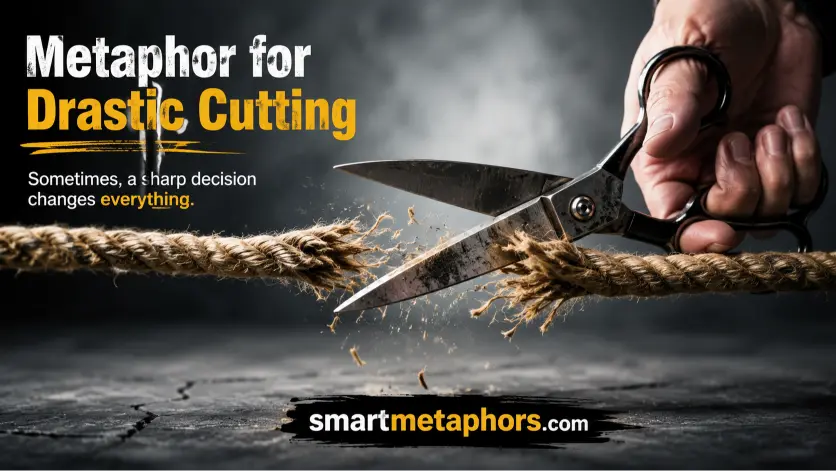
A metaphor for drastic cutting can make the idea of severe reduction much more vivid. Instead of simply saying that something was cut dramatically, a writer can compare it to a forest being cleared, a rope being severed, or a sculpture being stripped down to its core.
This type of figurative language works especially well when describing budget cuts, staff reductions, shortened plans, edited writing, reduced resources, or major changes.
The strongest metaphors do more than describe how much was removed. They also communicate what the reduction feels like.
Key Takeaways
- Metaphors can make drastic reduction easier to visualize.
- Different images can suggest loss, efficiency, shock, destruction, or transformation.
- The best metaphor depends on the context and emotional tone.
- Professional writing usually benefits from restrained imagery.
- Creative writing can use stronger and more dramatic comparisons.
- Fresh comparisons are more effective than familiar clichés.
What Is a Metaphor?
Definition of a Metaphor
A metaphor directly describes one thing as another to create a meaningful comparison.
For example:
“The project became a skeleton.”
This does not mean the project literally turned into a skeleton. It suggests that most of its original structure or resources were removed.
What Does Drastic Cutting Mean?
Drastic cutting refers to a large, sudden, or severe reduction.
It can describe:
- Budgets
- Staff
- Expenses
- Content
- Production
- Services
- Plans
- Resources
- Time
- Physical materials
Because the phrase can describe many situations, the metaphor should match what is being reduced.
How Metaphors Express Drastic Cutting
A metaphor can emphasize different aspects of reduction.
Loss
“The harvest was cut down to a handful of grain.”
This focuses on what disappeared.
Severity
“The axe fell across the entire plan.”
This suggests sudden and extensive reduction.
Simplification
“The proposal was carved down to its bones.”
This suggests removing everything unnecessary.
Destruction
“The scissors tore through the project’s foundations.”
This presents the reduction as damaging rather than helpful.
Transformation
“The sprawling plan became a narrow bridge.”
This suggests that cutting changed the original form into something much smaller.
Metaphors for Drastic Cutting
Metaphors of Sudden Removal
The axe fell across the plan.
Meaning: A major part of a plan was suddenly removed.
Best Use: Projects, policies, or proposals.
Tone: Dramatic
The scissors sliced through the budget.
Meaning: A budget was sharply reduced.
Best Use: Financial writing.
Tone: Direct
The knife cut the project down to size.
Meaning: A project was substantially reduced.
Best Use: Business or project discussions.
Tone: Practical
The pruning shears attacked the program.
Meaning: Large portions of a program were removed.
Best Use: Organizational writing.
Tone: Strong
The red pen stormed through the manuscript.
Meaning: A large amount of writing was deleted or edited.
Best Use: Editing and publishing.
Tone: Dramatic
Metaphors of Loss
The budget was a tree stripped of its branches.
Meaning: Major portions of available funding disappeared.
Best Use: Financial explanations.
Tone: Visual
The plan was a house missing half its rooms.
Meaning: Significant parts of a plan were removed.
Best Use: Planning and strategy.
Tone: Serious
The project was left with an empty toolbox.
Meaning: Most of its useful resources were taken away.
Best Use: Workplace writing.
Tone: Frustrated
The program became a shadow of itself.
Meaning: The program was reduced so heavily that little of its former strength remained.
Best Use: Formal and creative writing.
Tone: Emotional
The forest was reduced to a few stumps.
Meaning: A large amount was removed, leaving very little behind.
Best Use: Environmental or symbolic writing.
Tone: Powerful
Metaphors for Cutting Something Down to Its Core
The proposal was carved down to its bones.
Meaning: Everything unnecessary was removed.
Best Use: Editing, planning, and business.
Tone: Strong
The story was stripped to its skeleton.
Meaning: Most details were removed while the basic structure remained.
Best Use: Creative writing.
Tone: Literary
The plan was peeled down to its core.
Meaning: Only the essential elements remained.
Best Use: Strategy and project management.
Tone: Professional
The sculpture was reduced to its frame.
Meaning: Almost everything except the basic structure was removed.
Best Use: Creative and analytical writing.
Tone: Artistic
The idea was sharpened to a single point.
Meaning: A complicated idea was reduced to one central concept.
Best Use: Essays and professional communication.
Tone: Refined
Powerful Metaphors for Severe Reduction
The tide swallowed half the shore.
Meaning: A large portion disappeared suddenly.
Best Use: Dramatic descriptions.
Tone: Poetic
The storm tore the branches from the tree.
Meaning: A severe force caused major losses.
Best Use: Literary writing.
Tone: Dramatic
The fire ate through the structure.
Meaning: Something was rapidly and extensively reduced.
Best Use: Figurative storytelling.
Tone: Intense
The blade passed through the foundation.
Meaning: The cuts affected something fundamental.
Best Use: Serious situations.
Tone: Dark
The earthquake erased the old shape.
Meaning: A drastic change destroyed the previous structure.
Best Use: Transformational writing.
Tone: Powerful
Metaphors for Drastic Budget Cutting
The financial axe cleared the branches.
Meaning: Large portions of spending were removed.
Best Use: Business and finance.
Tone: Professional
The budget was put on a starvation diet.
Meaning: Available funding was severely restricted.
Best Use: Opinion writing and commentary.
Tone: Sharp
The purse was squeezed nearly dry.
Meaning: Very little money remained.
Best Use: Informal writing.
Tone: Vivid
The spending plan lost its wings.
Meaning: A plan could no longer support its original ambitions.
Best Use: Business writing.
Tone: Figurative
The budget became a thin stream.
Meaning: A large financial resource was reduced to a small amount.
Best Use: Reports and explanations.
Tone: Clear
Metaphors for Drastic Staff Cutting
The company trimmed its workforce to the bone.
Meaning: The number of employees was reduced severely.
Best Use: Business writing.
Tone: Strong
The team was cut down to its skeleton crew.
Meaning: Only the minimum number of workers remained.
Best Use: Workplace writing.
Tone: Direct
The department lost half its branches.
Meaning: Major parts of the department were removed.
Best Use: Organizational descriptions.
Tone: Professional
The workforce became a narrow bridge.
Meaning: A large team was reduced to a much smaller group carrying the remaining workload.
Best Use: Business analysis.
Tone: Creative
The office was pruned to its last leaves.
Meaning: Staffing was reduced extensively.
Best Use: Literary business writing.
Tone: Poetic
Metaphors for Drastic Editing
The editor took a machete to the manuscript.
Meaning: Large sections of writing were aggressively removed.
Best Use: Creative writing discussions.
Tone: Humorous and dramatic
The manuscript was carved to the bone.
Meaning: Extensive editing removed much of the original material.
Best Use: Publishing and writing.
Tone: Literary
The red pen became a lawn mower.
Meaning: The editor removed large amounts of unnecessary material.
Best Use: Humorous writing advice.
Tone: Funny
The paragraphs were trimmed into twigs.
Meaning: Large sections were shortened dramatically.
Best Use: Informal writing discussions.
Tone: Playful
The essay emerged as a skeleton.
Meaning: Most details were removed, leaving only the main structure.
Best Use: Academic or creative writing.
Tone: Descriptive
Nature-Inspired Metaphors
The forest was suddenly pruned.
Meaning: A large amount was removed from something that had previously been extensive.
Best Use: Projects, organizations, or systems.
Tone: Natural
Winter stripped the tree bare.
Meaning: Something lost most of its resources or features.
Best Use: Emotional or literary writing.
Tone: Poetic
The river was narrowed to a stream.
Meaning: Something large was reduced to a much smaller form.
Best Use: Resources or opportunities.
Tone: Elegant
The mountain was shaved into a hill.
Meaning: Something substantial was drastically reduced.
Best Use: Creative comparisons.
Tone: Vivid
The garden was left with only a few stems.
Meaning: Most of something was removed while a small remainder survived.
Best Use: Symbolic writing.
Tone: Emotional
Short and Simple Metaphors
The plan was a skeleton.
Meaning: Only the basic structure remained.
Best Use: Beginners.
Tone: Simple
The budget was a thin thread.
Meaning: Very little money remained.
Best Use: Financial contexts.
Tone: Clear
The team was a skeleton crew.
Meaning: Only essential workers remained.
Best Use: Workplace writing.
Tone: Direct
The project was a bare frame.
Meaning: Most of the original material was removed.
Best Use: General writing.
Tone: Simple
The idea was a single seed.
Meaning: A complex concept was reduced to its smallest essential form.
Best Use: Essays and creative writing.
Tone: Hopeful
Metaphor vs Simile
What Is a Metaphor?
A metaphor makes a direct comparison.
“The budget was a skeleton.”
What Is a Simile?
A simile uses “like” or “as” to make a comparison.
“The budget was like a skeleton.”
Why Use a Metaphor?
Metaphors tend to sound stronger and more direct.
Metaphor:
“The editor took a blade to the manuscript.”
Simile:
“The editor cut the manuscript like a blade through paper.”
The metaphor feels more immediate, while the simile makes the comparison more explicit.
How to Choose the Right Metaphor for Drastic Cutting
Consider What Is Being Cut
A budget, workforce, essay, forest, and project all require different imagery.
For example:
- Budget → purse, stream, axe
- Writing → blade, skeleton, red pen
- Staff → branches, skeleton crew, roots
- Plans → structure, bridge, frame
- Resources → river, toolbox, harvest
Decide Whether the Cutting Is Positive or Negative
Not every drastic cut is harmful.
If unnecessary material is being removed, use imagery such as:
“The proposal was carved to its core.”
If the reduction causes damage, stronger imagery works better:
“The axe fell across the foundation.”
Match the Emotional Intensity
For mild reduction, choose gentle imagery.
For severe loss, use stronger images such as:
- Axe
- Blade
- Storm
- Fire
- Bare tree
- Empty toolbox
Expert Writing Tips
Focus on the Result
A strong metaphor should show what remains after the cutting.
Instead of simply describing the action, show the aftermath:
“The sprawling project became a narrow bridge.”
This tells readers that the original scope was dramatically reduced.
Use Before-and-After Imagery
One of the strongest techniques is contrasting abundance with scarcity.
“The river became a trickle.”
The reader automatically imagines something that once carried much more.
Choose Metaphors With Natural Logic
The comparison should make sense.
A tree can be pruned.
A manuscript can be carved down.
A budget can be squeezed.
A team can be reduced to a skeleton crew.
This logical connection makes the metaphor easier to understand.
Avoid Making Every Cut Violent
Words such as axe, blade, and fire create harsh imagery. They are useful for severe or negative reductions but may be inappropriate for professional contexts.
For neutral writing, use:
- Pruning
- Narrowing
- Stripping
- Simplifying
- Carving
- Streamlining
Common Mistakes to Avoid
Using Violent Imagery in Formal Writing
“The company took a machete to its workforce” may sound too aggressive for a formal report.
A better alternative:
“The company significantly streamlined its workforce.”
Using the Same Metaphor Repeatedly
If every reduction becomes an “axe,” the writing quickly becomes predictable.
Rotate imagery between:
- Pruning
- Carving
- Narrowing
- Stripping
- Squeezing
- Shrinking
Making the Metaphor Too Complicated
A metaphor should clarify the idea, not create another puzzle for the reader.
Ignoring the Emotional Meaning
“The garden was pruned” sounds controlled.
“The forest was destroyed” sounds devastating.
The imagery changes the reader’s perception of the reduction.
Frequently Asked Questions
What is a metaphor for drastic cutting?
A metaphor for drastic cutting describes severe reduction through an imaginative comparison, such as “The budget was a tree stripped of its branches.”
What is a powerful metaphor for cutting something down?
“The project was carved down to its bones” is a powerful metaphor for reducing something until only its essential structure remains.
How do you describe drastic reduction creatively?
You can describe it as something being pruned, stripped bare, carved to the bone, narrowed to a stream, or reduced to a skeleton.
What metaphor can describe major budget cuts?
“The budget was squeezed nearly dry” effectively suggests that a large amount of available money has been removed.
What is a metaphor for drastic editing?
“The manuscript was carved to the bone” suggests that extensive editing removed large amounts of material while preserving the essential structure.
What is a metaphor for cutting staff?
“The workforce was reduced to a skeleton crew” suggests that only the minimum number of employees remained.
Conclusion
The right metaphor for drastic cutting can turn a plain statement about reduction into a vivid image of loss, transformation, or simplification. Whether you’re describing a shrinking budget, an edited manuscript, a reduced workforce, or a dramatically smaller plan, the metaphor should reflect both the scale of the cut and its emotional effect.
For professional writing, gentle images such as pruning, narrowing, and streamlining can communicate change clearly. For creative writing, stronger images such as axes, storms, bare forests, and skeletons can make the reduction feel immediate and powerful.
The most effective metaphor is not necessarily the most dramatic one. It is the one that helps the reader instantly understand what was removed, what remains, and why the change matters.

My Name is Alex Gard. I’m passionate about language, creative writing, and figurative expressions. Through SmartMetaphors, I help readers discover meaningful metaphors, similes, and literary devices to make their writing more engaging and impactful.