
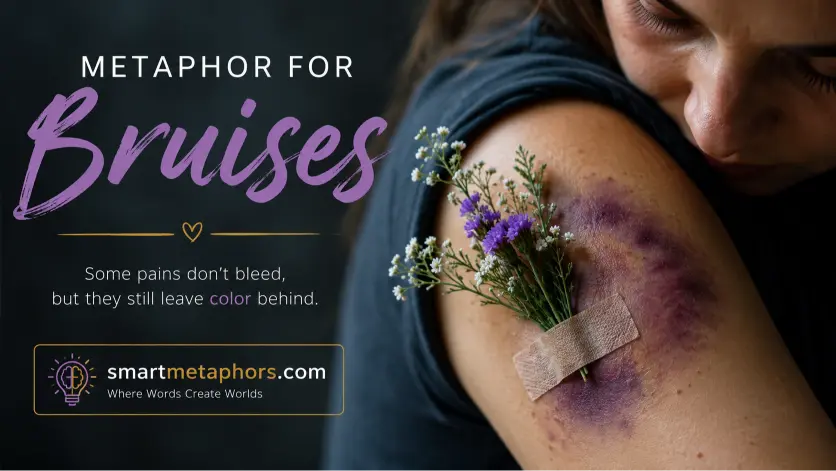
A metaphor for bruises can turn a simple physical mark into a powerful image of pain, vulnerability, memory, or healing. Instead of merely saying that someone had a dark bruise, a writer can describe it as “a shadow painted beneath the skin” or “a storm fading across the body.”
This makes the description more emotional and memorable.
Bruises can also work as symbols. In creative writing, they may represent emotional wounds, difficult experiences, forgotten memories, or the slow process of recovery.
Key Takeaways
- Metaphors can describe the color, shape, pain, and healing of bruises.
- A bruise can symbolize both physical and emotional hurt.
- Different metaphors create different moods.
- Dark imagery works well for pain and trauma, while softer imagery suits healing.
- The strongest metaphors connect a visible bruise with an understandable image or emotion.
- Context matters when choosing between dramatic, poetic, simple, or emotional imagery.
What Is a Metaphor?
Definition of a Metaphor
A metaphor directly describes one thing as another to create a figurative meaning.
For example:
“The bruise was a shadow beneath her skin.”
The bruise is not literally a shadow. The comparison emphasizes its dark appearance and lingering presence.
Why Use Metaphors for Bruises?
A plain description tells readers what a bruise looks like.
A metaphor can tell them what the bruise feels like.
Compare:
Plain:
The bruise was dark and painful.
Metaphorical:
The bruise was a storm trapped beneath his skin.
The second version creates an emotional picture rather than simply providing information.
How Metaphors Can Describe Bruises
A bruise can be described through several qualities.
Color
Darkness, shadows, ink, twilight, and clouds can suggest its changing color.
Pain
Storms, fire, thunder, and wounds can represent physical discomfort.
Memory
A bruise can become a stamp, photograph, or footprint representing something that happened.
Healing
Fading sunsets, disappearing clouds, melting ice, and closing doors can symbolize recovery.
Emotional Hurt
A physical bruise can become a metaphor for sadness, betrayal, grief, or vulnerability.
Creative Metaphors for Bruises
Nature-Inspired Metaphors
A storm trapped beneath the skin
Meaning: A bruise represents pain hidden beneath the surface.
Best Use: Emotional or dramatic writing.
Tone: Powerful
A fading sunset beneath the skin
Meaning: The changing colors of a bruise resemble the colors of a sunset.
Best Use: Poetic descriptions.
Tone: Beautiful and reflective
A cloud caught under the skin
Meaning: A soft but noticeable dark mark.
Best Use: Gentle descriptive writing.
Tone: Poetic
A shadow blooming on the skin
Meaning: A bruise gradually appearing and spreading.
Best Use: Literary fiction.
Tone: Artistic
A storm cloud on the body
Meaning: A dark bruise that suggests pain.
Best Use: Descriptive scenes.
Tone: Dramatic
Autumn beneath the skin
Meaning: The changing colors of a healing bruise resemble autumn leaves.
Best Use: Poetry and creative nonfiction.
Tone: Elegant
A midnight flower
Meaning: A dark bruise that has appeared against the skin.
Best Use: Literary writing.
Tone: Mysterious
A small eclipse
Meaning: A darkened area that interrupts the normal appearance of the skin.
Best Use: Short creative descriptions.
Tone: Poetic
A cloud losing its rain
Meaning: A bruise slowly fading as the body heals.
Best Use: Writing about recovery.
Tone: Hopeful
Winter melting into spring
Meaning: The bruise is disappearing as healing takes place.
Best Use: Symbolic writing.
Tone: Hopeful
Powerful Metaphors for Pain
A thunderclap beneath the skin
Meaning: Sudden and intense pain.
Best Use: Dramatic scenes.
Tone: Intense
A flame under the flesh
Meaning: A painful or burning sensation.
Best Use: Describing severe discomfort.
Tone: Dramatic
A warning flag on the body
Meaning: The bruise serves as visible evidence that something happened.
Best Use: Reflective writing.
Tone: Serious
A battlefield beneath the skin
Meaning: The body appears to carry evidence of struggle.
Best Use: Dramatic fiction or symbolic writing.
Tone: Heavy
A fingerprint left by pain
Meaning: A bruise becomes evidence of a painful event.
Best Use: Emotional storytelling.
Tone: Serious
A wound wearing a disguise
Meaning: A bruise may appear less severe than the pain behind it.
Best Use: Literary writing.
Tone: Thought-provoking
A bruise was a quiet scream
Meaning: Visible evidence of pain without any sound.
Best Use: Emotional prose.
Tone: Powerful
Pain’s signature
Meaning: A bruise is presented as a mark left behind by pain.
Best Use: Poetry and reflective writing.
Tone: Dark
Poetic Metaphors for Bruises
A violet whisper
Meaning: A subtle bruise expressed through delicate imagery.
Best Use: Poetry.
Tone: Soft
Ink spilled beneath the skin
Meaning: A dark bruise spreading across the body.
Best Use: Descriptive fiction.
Tone: Artistic
A painting made by pain
Meaning: The colors and patterns of a bruise become an unusual artwork.
Best Use: Literary writing.
Tone: Poetic
Twilight on the skin
Meaning: A bruise creates dark, fading colors.
Best Use: Elegant descriptions.
Tone: Poetic
A secret written in purple
Meaning: The bruise silently reveals that something happened.
Best Use: Symbolic storytelling.
Tone: Mysterious
A dark petal on the body
Meaning: A bruise resembles a flower petal through its shape or color.
Best Use: Poetry.
Tone: Delicate
A memory painted in shadows
Meaning: A bruise becomes a visible reminder of an event.
Best Use: Emotional writing.
Tone: Reflective
A piece of night beneath the skin
Meaning: A particularly dark bruise.
Best Use: Atmospheric fiction.
Tone: Mysterious
Metaphors for Bruises as Memories
A photograph written on the skin
Meaning: The bruise preserves a memory of what happened.
Best Use: Reflective storytelling.
Tone: Emotional
A footprint left by yesterday
Meaning: A bruise remains after the event has passed.
Best Use: Poetry and personal narratives.
Tone: Nostalgic
History written in purple
Meaning: The bruise carries evidence of the past.
Best Use: Literary writing.
Tone: Reflective
A timestamp on the body
Meaning: The bruise marks a particular moment in time.
Best Use: Symbolic prose.
Tone: Thoughtful
Yesterday’s shadow
Meaning: The past continues to leave a visible mark.
Best Use: Emotional writing.
Tone: Melancholic
A diary entry without words
Meaning: The bruise communicates a story without speaking.
Best Use: Fiction and poetry.
Tone: Emotional
Metaphors for Healing Bruises
A storm learning to disappear
Meaning: The bruise is gradually fading.
Best Use: Recovery-focused writing.
Tone: Hopeful
A sunset losing its colors
Meaning: The bruise is becoming lighter over time.
Best Use: Poetic descriptions.
Tone: Peaceful
A shadow retreating from the light
Meaning: The bruise is slowly disappearing.
Best Use: Symbolic writing.
Tone: Hopeful
Winter leaving the skin
Meaning: The painful mark is fading and healing.
Best Use: Literary writing.
Tone: Optimistic
A cloud breaking apart
Meaning: The dark appearance is gradually disappearing.
Best Use: Simple creative writing.
Tone: Gentle
Time erasing a dark painting
Meaning: Healing slowly removes the visible mark.
Best Use: Reflective prose.
Tone: Thoughtful
A tide pulling pain away
Meaning: The bruise and its discomfort are gradually fading.
Best Use: Poetic writing.
Tone: Calm
Simple Metaphors for Bruises
A shadow on the skin
Meaning: A dark mark left on the body.
Best Use: Beginner writing.
Tone: Simple
A purple cloud
Meaning: A colorful bruise.
Best Use: Descriptive writing.
Tone: Gentle
A dark stain
Meaning: A visible mark that stands out against the skin.
Best Use: Simple descriptions.
Tone: Neutral
A mark of pain
Meaning: A bruise represents physical discomfort.
Best Use: General writing.
Tone: Direct
A fading shadow
Meaning: A bruise that is healing.
Best Use: Recovery scenes.
Tone: Hopeful
A tiny storm
Meaning: A small bruise associated with pain.
Best Use: Creative beginner writing.
Tone: Simple
Metaphors for Emotional Bruises
Physical bruises can also inspire metaphors for emotional pain.
A bruise on the heart
Meaning: Emotional pain that remains after a difficult experience.
Best Use: Personal writing.
Tone: Emotional
A shadow over the soul
Meaning: Emotional suffering that affects someone’s inner life.
Best Use: Poetry.
Tone: Deep
A crack in the heart
Meaning: Emotional damage caused by loss or disappointment.
Best Use: Romantic or emotional writing.
Tone: Vulnerable
A scar before it becomes a scar
Meaning: Emotional pain that is still fresh and healing.
Best Use: Reflective storytelling.
Tone: Thoughtful
A storm inside the chest
Meaning: Strong emotional turmoil.
Best Use: Dramatic writing.
Tone: Intense
Metaphor vs Simile
What Is a Metaphor?
A metaphor makes a direct comparison.
Metaphor:
“The bruise was a small eclipse.”
What Is a Simile?
A simile uses “like” or “as” to make a comparison.
Simile:
“The bruise looked like a small eclipse.”
Side-by-Side Examples
| Metaphor | Simile |
|---|---|
| The bruise was a storm. | The bruise was like a storm. |
| Her arm carried a purple sunset. | Her arm looked like a purple sunset. |
| The mark was a shadow. | The mark was like a shadow. |
| His bruise was an ink stain. | His bruise was like an ink stain. |
Metaphors generally feel more direct and imaginative, while similes make the comparison more explicit.
How to Choose the Right Metaphor for Bruises
Think About the Purpose
First ask what you want the bruise to represent.
Is it:
- Physical pain?
- Emotional hurt?
- A past event?
- Healing?
- Vulnerability?
- Strength after suffering?
Your answer will guide your imagery.
Match the Emotional Intensity
For mild imagery, choose something such as:
“A cloud beneath the skin.”
For stronger imagery:
“A battlefield beneath the skin.”
For emotional writing:
“A fingerprint left by pain.”
Match the Tone
A children’s story may need simple imagery, while a novel or poem can support deeper symbolism.
Consider the Color
The colors of bruises can inspire metaphors involving:
- Twilight
- Ink
- Storm clouds
- Autumn
- Shadows
- Night
- Flowers
This gives the description a visual foundation.
Expert Writing Tips
Turn Appearance Into Meaning
Don’t describe only what the bruise looks like. Think about what it represents.
Instead of:
“A dark bruise covered his arm.”
Try:
“His arm carried yesterday’s shadow.”
Now the bruise has a connection to the past.
Use Unexpected Comparisons
Fresh imagery makes descriptions more memorable.
Instead of repeatedly using shadow, experiment with objects, landscapes, weather, music, or time.
Let the Context Guide the Metaphor
A bruise in a peaceful scene might become “a fading sunset.”
A bruise in a tense scene might become “a warning flag.”
The same physical mark can communicate completely different emotions.
Don’t Make Every Bruise Dramatic
Sometimes a simple metaphor is more effective.
“A purple cloud beneath the skin” may work better than an elaborate comparison when the scene is quiet.
Common Mistakes to Avoid
Using the Same Imagery Repeatedly
If every bruise becomes a shadow, your writing can feel predictable.
Better: Explore storms, ink, sunsets, flowers, footprints, or fading clouds.
Making the Metaphor Too Dark
Not every bruise needs to symbolize trauma or tragedy.
Use gentle imagery when the context calls for it.
Choosing an Unclear Comparison
Readers should understand the connection without having to solve a puzzle.
Overloading the Description
One strong metaphor is usually more effective than several competing metaphors.
Frequently Asked Questions
What is a metaphor for bruises?
A metaphor for bruises describes a bruise through an imaginative comparison, such as “a shadow beneath the skin” or “a storm trapped beneath the flesh.”
What is a good metaphor for a painful bruise?
“A thunderclap beneath the skin” is a strong metaphor for a painful bruise because it suggests sudden and intense discomfort.
What is a poetic metaphor for a bruise?
“Twilight on the skin” is a poetic metaphor that uses the changing dark colors of a bruise to create beautiful visual imagery.
Can a bruise be a metaphor for emotional pain?
Yes. A bruise can symbolize emotional hurt, vulnerability, memory, or suffering. For example, “a bruise on the heart” represents lingering emotional pain.
What is a metaphor for a healing bruise?
“A storm learning to disappear” can represent a bruise gradually fading as the body heals.
How do you describe a bruise creatively?
Use imagery connected to its color, shape, pain, or changing appearance. Words and ideas involving storms, shadows, ink, sunsets, clouds, and fading light can create vivid descriptions.
Conclusion
A creative metaphor for bruises can turn a simple physical mark into a vivid image of pain, memory, vulnerability, or healing. A bruise can become a storm beneath the skin, ink spilled across the body, a fading sunset, or a fingerprint left by pain depending on the emotion you want to express.
The strongest metaphor depends on your context. Choose darker imagery when you want to emphasize pain, softer imagery when you want to suggest healing, and symbolic imagery when the bruise represents something deeper. When the comparison feels natural and meaningful, even a small mark can become a powerful piece of writing.

My Name is Alex Gard. I’m passionate about language, creative writing, and figurative expressions. Through SmartMetaphors, I help readers discover meaningful metaphors, similes, and literary devices to make their writing more engaging and impactful.