
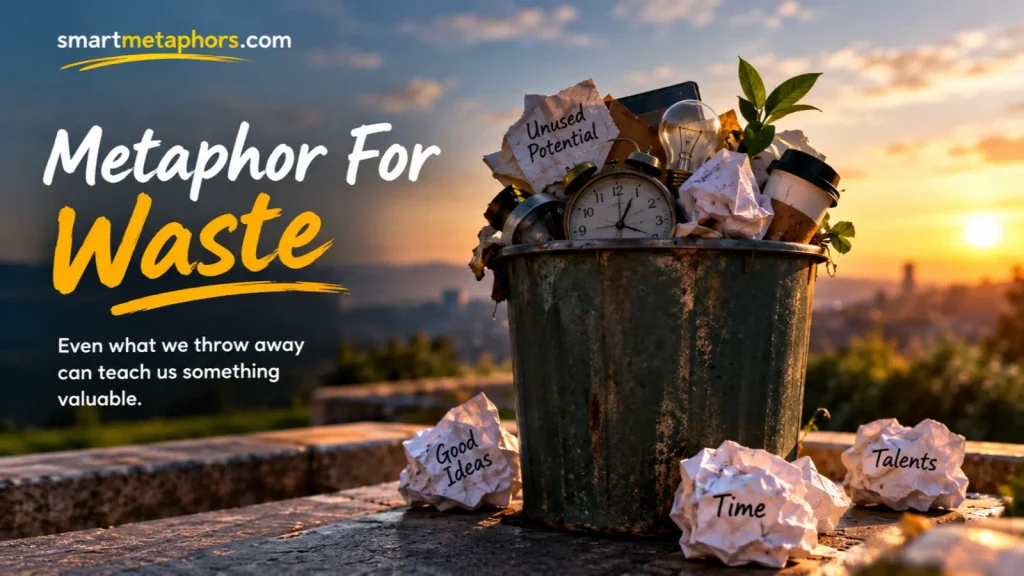
A metaphor for waste can turn an ordinary description of wasted time, money, or resources into a powerful image that readers remember. Instead of simply saying that someone wasted an opportunity, you could describe it as a golden key thrown into the ocean.
Waste can take many forms. It can mean throwing away useful materials, spending money carelessly, losing precious time, or allowing valuable opportunities to disappear. The right metaphor helps communicate not only what was wasted but also why that waste matters.
Whether you’re writing an essay, a story, a speech, an environmental article, or a school assignment, these metaphors will help you express wastefulness with greater clarity and creativity.
Key Takeaways
- Metaphors make waste and loss easier to visualize.
- Different metaphors can describe wasted time, money, resources, and opportunities.
- Strong imagery helps readers understand the consequences of waste.
- The best metaphor matches the context, audience, and emotional tone.
- Original comparisons can make environmental and everyday writing more memorable.
What Is a Metaphor?
Definition of a Metaphor
A metaphor is a figure of speech that describes one thing as another to highlight a shared quality. It does not use the words “like” or “as” to make the comparison.
For example:
“Time is a leaking bucket.”
Time does not literally leak from a bucket. The metaphor suggests that valuable moments are slipping away without being used wisely.
Why Writers Use Metaphors
Writers use metaphors to make abstract ideas easier to understand. Waste is often invisible until its consequences become clear. A metaphor gives that loss a recognizable shape.
For example:
- “Money is smoke in his hands” suggests careless spending.
- “The opportunity was a door left unopened” suggests a missed chance.
- “The landfill is a mountain of forgotten choices” highlights the lasting consequences of discarded materials.
How Metaphors Express Waste
Waste is not always about rubbish. It can also mean losing something valuable through carelessness, neglect, or poor decisions.
Wasted Time
Time waste can be described through clocks, leaking containers, disappearing shadows, and unfinished journeys.
Wasted Money
Financial waste can be represented by leaking wallets, burning cash, or pouring coins into a bottomless well.
Wasted Resources
Environmental waste can be expressed through empty rivers, overflowing landfills, or gardens left to wither.
Wasted Opportunities
Missed opportunities can be represented by unopened doors, abandoned bridges, or seeds left unplanted.
Creative Metaphors for Waste
Everyday Metaphors for Waste
A leaking bucket
Meaning: Valuable things disappear little by little without anyone noticing.
Example: His monthly salary was a leaking bucket, draining away before the bills were paid.
Best Use: Everyday spending and gradual losses.
Tone: Simple and relatable.
A hole in the pocket
Meaning: Money disappears quickly because of frequent spending.
Example: Her shopping habit was a hole in her pocket.
Best Use: Casual conversations and personal writing.
Tone: Humorous.
A broken machine
Meaning: Resources are being used without producing useful results.
Example: The outdated process was a broken machine consuming hours without delivering progress.
Best Use: Workplaces and inefficient systems.
Tone: Critical.
An empty basket
Meaning: Effort or spending produces little or nothing of value.
Example: After months of careless planning, the project was an empty basket.
Best Use: Stories and reflective essays.
Tone: Disappointed.
A road leading nowhere
Meaning: Time and energy are spent without reaching a meaningful goal.
Example: Their endless arguments were a road leading nowhere.
Best Use: Relationships, projects, and decision-making.
Tone: Reflective.
Metaphors for Wasted Time
A clock swallowing minutes
Meaning: Time passes without meaningful progress.
Example: Endless scrolling was a clock swallowing minutes of his life.
Best Use: Productivity articles and personal essays.
Tone: Thought-provoking.
Sand slipping through the fingers
Meaning: Precious time disappears despite attempts to hold onto it.
Example: Her free afternoons were sand slipping through her fingers.
Best Use: Reflective writing.
Tone: Poetic.
A train running in circles
Meaning: Repeated activity leads nowhere.
Example: Without a clear plan, the team’s meetings became a train running in circles.
Best Use: Workplace writing.
Tone: Critical.
A candle burning in an empty room
Meaning: Time or effort is spent where it benefits no one.
Example: His late-night labor was a candle burning in an empty room.
Best Use: Fiction and emotional writing.
Tone: Melancholic.
A river flowing into the desert
Meaning: Valuable time and effort are lost without creating results.
Example: Teaching without the necessary support felt like a river flowing into the desert.
Best Use: Education and professional reflection.
Tone: Serious.
Metaphors for Wasted Money
Money poured into a bottomless well
Meaning: Money is spent continuously without producing a worthwhile outcome.
Example: Without a budget, the renovation became money poured into a bottomless well.
Best Use: Financial discussions and business writing.
Tone: Warning.
Cash going up in smoke
Meaning: Money disappears without providing lasting value.
Example: Buying things he never used was cash going up in smoke.
Best Use: Everyday spending.
Tone: Direct.
A wallet with a broken lock
Meaning: Money leaves too easily because spending is poorly controlled.
Example: His wallet was a broken lock, opening for every unnecessary purchase.
Best Use: Humorous writing.
Tone: Playful.
Gold traded for dust
Meaning: Something valuable is exchanged for something nearly worthless.
Example: Selling the family business for a quick thrill was gold traded for dust.
Best Use: Stories and discussions about poor decisions.
Tone: Dramatic.
A furnace eating coins
Meaning: Money is continually consumed by unnecessary expenses.
Example: The poorly maintained equipment was a furnace eating coins.
Best Use: Business and household budgeting.
Tone: Cautionary.
Metaphors for Wasted Resources
A garden left to wither
Meaning: Valuable resources are neglected until they lose their usefulness.
Example: The unused farmland was a garden left to wither.
Best Use: Agriculture and environmental writing.
Tone: Sad.
A mountain of discarded chances
Meaning: Waste accumulates because useful opportunities or materials are thrown away.
Example: The factory floor was a mountain of discarded chances, filled with materials that could have been reused.
Best Use: Sustainability articles.
Tone: Reflective.
A river poisoned by neglect
Meaning: Carelessness damages a resource that should have been protected.
Example: The polluted stream was a river poisoned by neglect.
Best Use: Environmental essays.
Tone: Serious.
A pantry full of forgotten food
Meaning: Useful supplies are allowed to spoil because they are ignored.
Example: Their refrigerator was a pantry full of forgotten food, with perfectly good meals expiring every week.
Best Use: Food waste discussions.
Tone: Practical.
A forest turned into ashes
Meaning: Natural wealth is destroyed through careless use or exploitation.
Example: Uncontrolled logging turned the thriving woodland into a forest turned into ashes.
Best Use: Environmental storytelling.
Tone: Dramatic.
Metaphors for Wasted Opportunities
A golden key thrown into the ocean
Meaning: A valuable opportunity is discarded and becomes difficult to recover.
Example: Rejecting the scholarship without considering its benefits was a golden key thrown into the ocean.
Best Use: Motivational writing and personal stories.
Tone: Regretful.
A door sealed with dust
Meaning: An opportunity remains unused until it becomes difficult to access.
Example: His creative talent became a door sealed with dust because he never pursued it.
Best Use: Personal development.
Tone: Reflective.
Seeds left in a drawer
Meaning: Potential is ignored instead of being developed.
Example: Her business ideas were seeds left in a drawer.
Best Use: Entrepreneurship and education.
Tone: Inspirational.
A bridge abandoned halfway
Meaning: Progress is wasted because a task is left unfinished.
Example: The unfinished training program was a bridge abandoned halfway.
Best Use: Projects and professional development.
Tone: Critical.
A ship refusing the harbor
Meaning: A person fails to take advantage of a safe or beneficial opportunity.
Example: He rejected every reasonable offer, becoming a ship refusing the harbor.
Best Use: Fiction and life lessons.
Tone: Thoughtful.
Funny Metaphors for Waste
A vacuum cleaner eating money
Meaning: A habit or purchase consumes money at an alarming rate.
Example: His collection of unnecessary gadgets was a vacuum cleaner eating money.
Best Use: Humorous articles.
Tone: Funny.
A refrigerator for expired dreams
Meaning: A place where plans are stored until they lose their usefulness.
Example: Her abandoned project folder was a refrigerator for expired dreams.
Best Use: Creative writing.
Tone: Witty.
A leaky boat carrying buckets
Meaning: Trying to solve waste with methods that create even more waste.
Example: Buying more disposable products to manage household clutter was a leaky boat carrying buckets.
Best Use: Everyday humor.
Tone: Satirical.
A gold-plated paperweight
Meaning: Something expensive that serves little practical purpose.
Example: The unused office gadget was a gold-plated paperweight.
Best Use: Workplace humor and consumer criticism.
Tone: Sarcastic.
A bakery throwing away its bread
Meaning: Discarding something useful while having the ability to make good use of it.
Example: Ignoring the team’s best ideas was a bakery throwing away its bread.
Best Use: Management and teamwork.
Tone: Humorous.
Powerful Metaphors for Waste
A furnace consuming tomorrow
Meaning: Wasteful choices today damage future possibilities.
Example: Burning through natural resources without planning was a furnace consuming tomorrow.
Best Use: Environmental and economic writing.
Tone: Urgent.
A treasure chest buried in mud
Meaning: Valuable resources are hidden or ruined by neglect.
Example: The abandoned archive was a treasure chest buried in mud.
Best Use: Historical writing and storytelling.
Tone: Dramatic.
A candle fighting the daylight
Meaning: Effort is wasted trying to accomplish something unnecessary or ineffective.
Example: Continuing a failing strategy without reviewing the evidence was a candle fighting the daylight.
Best Use: Essays and professional analysis.
Tone: Critical.
A kingdom built on leaking foundations
Meaning: A system wastes resources because its basic structure is flawed.
Example: The company’s spending model was a kingdom built on leaking foundations.
Best Use: Business writing.
Tone: Serious.
An hourglass filled with holes
Meaning: Time disappears faster than expected because of poor habits or planning.
Example: His daily routine was an hourglass filled with holes.
Best Use: Productivity writing.
Tone: Reflective.
Literary and Poetic Metaphors for Waste
A song swallowed by silence
Meaning: Talent or effort goes unnoticed and unused.
Example: Her beautiful writing became a song swallowed by silence when she stopped sharing it.
Best Use: Poetry and fiction.
Tone: Melancholic.
A sunset locked in a room
Meaning: Beauty or potential is prevented from being experienced.
Example: Keeping his paintings hidden was a sunset locked in a room.
Best Use: Artistic writing.
Tone: Poetic.
A river forgetting the sea
Meaning: Energy and progress lose direction before reaching their purpose.
Example: Without a clear goal, their ambition became a river forgetting the sea.
Best Use: Reflective essays.
Tone: Philosophical.
A garden of unpicked fruit
Meaning: Opportunities or rewards are allowed to go unused.
Example: The neglected research findings were a garden of unpicked fruit.
Best Use: Academic and literary writing.
Tone: Thoughtful.
Gold fading into the shadows
Meaning: Something valuable loses its importance because it is ignored.
Example: His natural talent was gold fading into the shadows.
Best Use: Character development and personal reflection.
Tone: Emotional.
Metaphor vs. Simile
A metaphor directly describes one thing as another, while a simile compares two things using “like” or “as.”
Metaphor
Time is a leaking bucket.
This directly presents time as something that loses its contents.
Simile
Time is like a leaking bucket.
This compares time to a leaking bucket without directly equating them.
When Should You Use Each?
Use a metaphor when you want a direct, memorable image. Use a simile when you want to explain a comparison more explicitly.
For example, in an environmental essay, “The landfill is a mountain of forgotten resources” makes waste feel large and consequential. In a simpler explanation, “The landfill is like a mountain of forgotten resources” makes the comparison more explicit.
How to Choose the Right Metaphor for Waste
Consider What Is Being Wasted
Choose imagery that fits the subject.
- Time: A clock swallowing minutes.
- Money: A furnace eating coins.
- Food: A pantry full of forgotten food.
- Natural resources: A garden left to wither.
- Opportunities: A golden key thrown into the ocean.
Match the Emotional Tone
A funny article might use “a vacuum cleaner eating money.” A serious environmental essay might use “a furnace consuming tomorrow.”
Think About Your Audience
For younger students, simple comparisons such as “a leaking bucket” are easy to understand. For advanced creative writing, images such as “a song swallowed by silence” can create more emotional depth.
Focus on the Consequences
The strongest metaphor does more than identify waste. It reveals what the waste costs.
Compare these statements:
- Basic: “The company wasted money.”
- More vivid: “The company’s budget was a furnace eating coins.”
- More analytical: “The company’s budget was a furnace eating coins, consuming funds that could have supported better equipment and training.”
The final version connects imagery with a real consequence.
Expert Writing Tips
Create Original Comparisons
Think about how waste happens. Does something leak, rot, burn, disappear, or remain unused? Use that process to build your metaphor.
For example, instead of saying “The project wasted time,” write:
“The project was a clockwork machine built to produce delays.”
This highlights not only wasted time but also the system causing it.
Use Specific Details
Specific details make a metaphor more convincing.
Instead of “The food was wasted,” try:
“The untouched meals became a garden of forgotten harvests.”
The second description creates a clearer image of food that could have been enjoyed but was abandoned.
Connect the Metaphor to a Real Problem
Metaphors work best when readers understand their relevance. If you are writing about plastic waste, imagery involving overflowing bins, polluted rivers, and buried resources may be more effective than a metaphor about lost money.
Avoid Mixing Metaphors
Keep the central image consistent.
Confusing: “Time was a leaking bucket racing down a burning road.”
Clearer: “Time was a leaking bucket, losing precious minutes with every step.”
Common Mistakes to Avoid
Using Clichés Without Adding Meaning
Phrases such as “money down the drain” are familiar and easy to understand, but they may not make your writing distinctive.
Better alternative: “His savings became a river flowing into a bottomless well.”
Choosing an Unclear Comparison
A metaphor should help the reader understand the idea, not make it harder to follow.
Better alternative: Replace an abstract image with something readers can easily picture, such as a leaking bucket or an abandoned garden.
Ignoring the Type of Waste
A metaphor about burning money may not be the best choice for describing food waste.
Better alternative: Use imagery that connects directly to the subject, such as a table full of untouched meals.
Overusing Dramatic Language
Not every wasteful action needs to be described as a disaster.
Better alternative: Use a gentle metaphor for minor waste and stronger imagery when the consequences are serious.
Frequently Asked Questions
What is a metaphor for waste?
A metaphor for waste is a figurative expression that represents wasted resources, time, money, or opportunities through an imaginative comparison. For example, “Time is a leaking bucket” suggests that valuable moments are disappearing.
What is a good metaphor for wasting time?
“A clock swallowing minutes” is a good metaphor for wasting time because it suggests that moments are disappearing without producing anything useful.
What is a metaphor for wasting money?
“Money poured into a bottomless well” describes spending that continues without delivering meaningful results.
What is a metaphor for waste in the environment?
“A mountain of discarded resources” represents the accumulation of materials that could have been reused, recycled, or put to better use.
How do you describe a wasted opportunity metaphorically?
You can describe a wasted opportunity as “a golden key thrown into the ocean” or “seeds left in a drawer.” Both images suggest that something valuable was ignored or discarded.
Why are metaphors useful when writing about waste?
Metaphors make waste easier to visualize and help readers understand its consequences. They can turn abstract losses into memorable images that encourage reflection or action.
What is the difference between a metaphor for waste and a simile for waste?
A metaphor directly compares waste to something else, such as “Waste is a leaking pipe.” A simile uses “like” or “as,” such as “Waste spreads like water through a broken pipe.”
Conclusion
A creative metaphor for waste can reveal the hidden cost of careless decisions, unused resources, wasted time, and missed opportunities. Images such as a leaking bucket, a furnace eating coins, or a garden of unpicked fruit help readers picture what is being lost and why it matters.
The most effective metaphor matches the subject, creates a clear mental image, and communicates a meaningful consequence. By choosing original comparisons and connecting them to real situations, you can make your writing more vivid, persuasive, and memorable.

My Name is Alex Gard. I’m passionate about language, creative writing, and figurative expressions. Through SmartMetaphors, I help readers discover meaningful metaphors, similes, and literary devices to make their writing more engaging and impactful.