
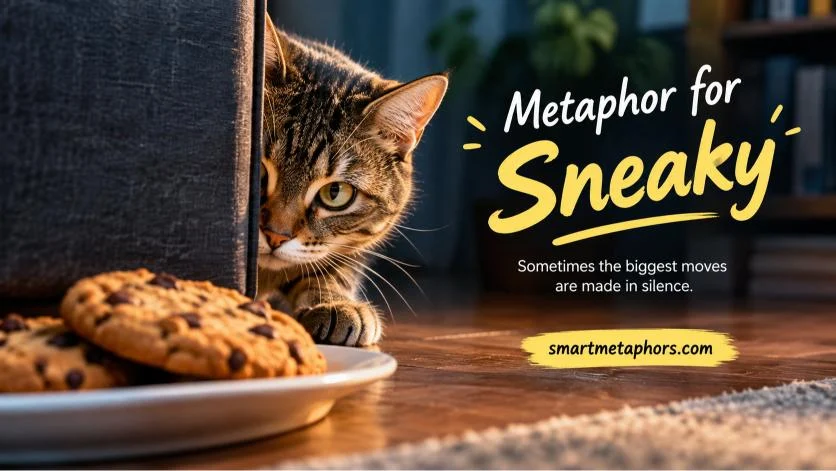
A metaphor for sneaky can turn a simple description of secretive behavior into vivid and memorable writing. Instead of saying someone is sneaky, you can describe them as a shadow slipping through a doorway, a fox moving through tall grass, or a whisper hiding in the dark.
Sneakiness can mean many things. Someone may be quietly clever, secretly dishonest, playfully mischievous, or carefully avoiding attention. The best metaphor depends on the exact kind of behavior you want to describe.
This guide explores creative ways to describe sneaky people, actions, movements, and intentions while helping you choose imagery that fits your tone and audience.
Key Takeaways
- Metaphors make sneaky behavior easier to visualize.
- Animals, shadows, darkness, smoke, and hidden objects work well as metaphorical imagery.
- A metaphor can make sneakiness sound playful, mysterious, clever, or threatening.
- The strongest metaphor matches the character’s intention and behavior.
- Original comparisons are more memorable than predictable descriptions.
What Is a Metaphor?
Definition of a Metaphor
A metaphor directly describes one thing as another to create a comparison.
For example:
“He was a shadow in the hallway.”
The person is not literally a shadow. The metaphor suggests that he moved quietly, stayed unnoticed, and appeared difficult to detect.
Why Metaphors Work
Metaphors allow writers to communicate several ideas at once.
A single image can suggest:
- Secrecy
- Silence
- Cunning
- Deception
- Mystery
- Stealth
- Avoidance
- Unpredictability
How Metaphors Express Sneakiness
Sneakiness is not always negative. A child sneaking toward a birthday surprise may be playful, while someone secretly manipulating another person may be dishonest.
This difference matters.
A shadow suggests quiet movement.
A fox can suggest cleverness.
A snake in the grass suggests hidden danger.
A whisper behind a curtain suggests mystery.
Choosing the right image gives your reader clues about the person’s intentions.
Why Writers Use Metaphors for Sneaky Behavior
To Show Instead of Tell
Instead of:
“He was sneaky.”
Try:
“He moved through the room like a shadow with a secret.”
The second sentence gives the reader an image rather than simply stating a personality trait.
To Build Suspense
Sneaky metaphors can make readers wonder what will happen next.
“Something moved beneath the surface, silent as a buried thought.”
This creates mystery without explaining everything.
To Reveal Character
A metaphor can also tell readers what kind of sneaky person they are dealing with.
A fox suggests cleverness.
A snake suggests danger.
A cat suggests quiet movement.
Smoke suggests something difficult to grasp.
Metaphor for Sneaky
Shadow-Based Metaphors
A shadow with a secret
Meaning: Someone who hides their intentions.
Best Use: Fiction and suspense.
Tone: Mysterious
A shadow slipping through the cracks
Meaning: Someone who finds ways to remain unnoticed.
Best Use: Storytelling.
Tone: Dark
A whisper in the darkness
Meaning: Something happening quietly and secretly.
Best Use: Poetry and dramatic writing.
Tone: Mysterious
A ghost behind the curtain
Meaning: Someone present but difficult to detect.
Best Use: Suspenseful scenes.
Tone: Eerie
A footprint that disappears in the rain
Meaning: Someone who leaves little evidence behind.
Best Use: Mystery writing.
Tone: Intriguing
A secret wearing human clothes
Meaning: Someone whose true intentions are hidden.
Best Use: Character descriptions.
Tone: Literary
Animal-Inspired Metaphors
A fox in the henhouse
Meaning: A clever person secretly entering a vulnerable situation.
Best Use: Describing manipulation or deception.
Tone: Warning
A cat walking on velvet
Meaning: Someone moving extremely quietly.
Best Use: Physical movement.
Tone: Elegant
A snake beneath the grass
Meaning: Hidden danger or dishonesty.
Best Use: Serious writing.
Tone: Threatening
A spider behind the web
Meaning: Someone secretly controlling events.
Best Use: Villainous characters.
Tone: Dark
A wolf behind a friendly smile
Meaning: Someone who appears harmless while hiding dangerous intentions.
Best Use: Character descriptions.
Tone: Suspicious
A fox wearing a sheep’s coat
Meaning: A clever person pretending to be innocent.
Best Use: Fiction and storytelling.
Tone: Cunning
A mouse beneath the table
Meaning: Someone quietly observing without attracting attention.
Best Use: Everyday descriptions.
Tone: Subtle
An owl hiding in daylight
Meaning: Someone deliberately staying unnoticed.
Best Use: Poetic writing.
Tone: Mysterious
Dark and Mysterious Metaphors
Smoke under a locked door
Meaning: Something suspicious that is quietly revealing itself.
Best Use: Suspense.
Tone: Ominous
A knife hidden in velvet
Meaning: Danger concealed behind a pleasant appearance.
Best Use: Villain descriptions.
Tone: Dark
A locked door with a smile
Meaning: Someone friendly on the outside but secretive underneath.
Best Use: Character development.
Tone: Suspicious
Darkness wearing a disguise
Meaning: Hidden wrongdoing or deception.
Best Use: Literary writing.
Tone: Dramatic
A secret buried beneath silk
Meaning: Something hidden behind elegance or charm.
Best Use: Poetry and fiction.
Tone: Mysterious
A cold breeze through a closed window
Meaning: Something strange happening without an obvious explanation.
Best Use: Suspenseful scenes.
Tone: Eerie
A hidden hand moving the pieces
Meaning: Someone secretly controlling a situation.
Best Use: Politics, business, fiction, or strategy writing.
Tone: Powerful
Funny Metaphors for Sneaky Behavior
A cat planning a refrigerator heist
Meaning: Someone behaving suspiciously in a humorous way.
Best Use: Casual writing.
Tone: Funny
A ninja wearing squeaky shoes
Meaning: Someone trying to be sneaky but failing.
Best Use: Comedy.
Tone: Playful
A magician hiding the remote
Meaning: Someone secretly moving or taking something.
Best Use: Everyday humor.
Tone: Lighthearted
A raccoon with a master plan
Meaning: Someone behaving suspiciously but cleverly.
Best Use: Social media and casual writing.
Tone: Funny
A whisper with muddy footprints
Meaning: Someone attempting to hide their actions but leaving obvious clues.
Best Use: Humorous storytelling.
Tone: Playful
Clever and Cunning Metaphors
A chess player behind the curtain
Meaning: Someone quietly planning several moves ahead.
Best Use: Strategic characters.
Tone: Intelligent
A chess piece moving in the dark
Meaning: Someone acting secretly as part of a larger plan.
Best Use: Fiction and strategy writing.
Tone: Mysterious
A fox carrying a map
Meaning: A clever person who knows exactly where they are going.
Best Use: Character descriptions.
Tone: Clever
A chessboard beneath the table
Meaning: A hidden strategy operating beneath visible events.
Best Use: Business or political fiction.
Tone: Strategic
A card hidden up the sleeve
Meaning: Someone secretly holding an advantage.
Best Use: Competitive situations.
Tone: Clever
Nature-Inspired Metaphors
Fog hiding the road
Meaning: Someone’s intentions are unclear.
Best Use: Reflective or mysterious writing.
Tone: Atmospheric
Wind moving through closed windows
Meaning: Something happening quietly and unexpectedly.
Best Use: Poetry.
Tone: Mysterious
A river flowing underground
Meaning: Secret activity continuing beneath the surface.
Best Use: Literary writing.
Tone: Thoughtful
A vine climbing in the darkness
Meaning: Quiet progress happening without notice.
Best Use: Symbolic writing.
Tone: Poetic
A moon hiding behind clouds
Meaning: Someone deliberately concealing themselves.
Best Use: Descriptive writing.
Tone: Gentle
Short and Simple Metaphors for Sneaky
A silent shadow
Someone who avoids attention.
A hidden fox
Someone who is clever and secretive.
A quiet snake
Someone whose intentions may be dangerous.
A masked thought
An intention that remains concealed.
A secret door
Something hidden from view.
A whispering wind
Something subtle and difficult to notice.
A disappearing footprint
Someone who leaves little evidence.
A hidden hand
Someone secretly influencing events.
A silent mouse
Someone who moves without attracting attention.
A dark curtain
Something concealing what is happening behind it.
Metaphor vs Simile
What Is a Metaphor?
A metaphor makes a direct comparison.
“She was a shadow.”
This suggests that she was quiet, difficult to notice, or constantly following someone.
What Is a Simile?
A simile uses “like” or “as.”
“She moved like a shadow.”
The comparison is more explicit.
Which One Is More Effective?
Both are useful.
Metaphors often feel stronger and more literary, while similes can make an image easier to understand.
How to Choose the Right Metaphor for Sneaky
Think About the Type of Sneakiness
Ask what the person is actually doing.
Are they:
- Moving quietly?
- Hiding information?
- Planning secretly?
- Manipulating someone?
- Playing a harmless prank?
- Avoiding responsibility?
The answer should guide your metaphor.
Match the Emotional Tone
For playful sneakiness, use images such as:
- A mischievous cat
- A raccoon with a plan
- A ninja with squeaky shoes
For serious deception, consider:
- A snake beneath the grass
- A knife hidden in velvet
- A hidden hand
Consider Your Audience
Children may respond better to simple animal imagery, while literary readers may appreciate symbolic metaphors involving shadows, smoke, darkness, and hidden doors.
Expert Writing Tips
Focus on Behavior, Not Just the Label
Instead of trying to find a metaphor that simply means “sneaky,” identify the behavior first.
Someone who moves silently needs different imagery from someone who secretly manipulates others.
Use Unexpected Connections
Fresh metaphors make writing memorable.
Instead of saying:
“He was a fox.”
Try:
“He was a fox carrying a map.”
The added detail suggests that the person’s cleverness is deliberate and purposeful.
Let the Image Carry the Meaning
Don’t explain every part of a metaphor.
For example:
“A hidden hand moved the pieces.”
The reader can understand the idea of secret control without a long explanation.
Avoid Making Every Sneaky Character Evil
Sneakiness can be playful, clever, cautious, secretive, or deceptive.
Your metaphor should reflect the actual character.
Common Mistakes to Avoid
Using the Same Animal Metaphors
Foxes and snakes are common symbols of cunning and deception. They can work, but fresh imagery often creates a stronger impression.
Making the Metaphor Too Complicated
If readers need several sentences to understand the comparison, simplify it.
Using a Dark Metaphor for a Playful Situation
Calling a child a “knife hidden in velvet” would create a very different feeling from calling them “a raccoon with a master plan.”
Confusing Quietness With Deception
Someone can be quiet without being dishonest.
Choose a metaphor that reflects the specific behavior.
Frequently Asked Questions
What is a metaphor for sneaky?
A metaphor for sneaky describes secretive or cunning behavior through an indirect comparison. For example, “He was a shadow with a secret” suggests someone who hides their intentions.
What are some powerful metaphors for sneaky?
Examples include “a snake beneath the grass,” “a hidden hand,” “a knife hidden in velvet,” and “a shadow slipping through the cracks.”
How do you describe someone sneaky creatively?
Compare the person to something that moves, hides, or operates secretly, such as a shadow, fox, snake, whisper, fog, or hidden hand.
What is a metaphor for someone who secretly manipulates others?
“A hidden hand moving the pieces” is an effective metaphor because it suggests someone secretly controlling events without being seen.
What is a funny metaphor for sneaky?
“A ninja wearing squeaky shoes” is a humorous metaphor for someone who tries to be stealthy but makes their presence obvious.
Can sneaky metaphors be positive?
Yes. Sneakiness can describe playful cleverness, quiet problem-solving, or strategic behavior. The metaphor should match the intended meaning.
Conclusion
A strong metaphor for sneaky can turn an ordinary description into vivid imagery. Shadows, foxes, snakes, smoke, hidden hands, and quiet natural forces all provide different ways to express secrecy and stealth.
The key is to match the metaphor to the kind of sneakiness you’re describing. A playful character may need a funny image, while a mysterious character may call for darker imagery. When the comparison fits the behavior, your writing becomes clearer, more memorable, and more engaging

My Name is Alex Gard. I’m passionate about language, creative writing, and figurative expressions. Through SmartMetaphors, I help readers discover meaningful metaphors, similes, and literary devices to make their writing more engaging and impactful.