
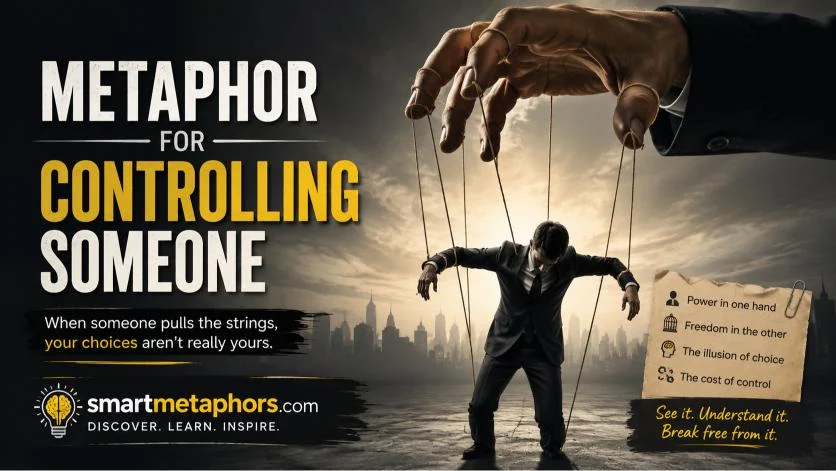
A metaphor for controlling someone can turn an ordinary description of manipulation or authority into a vivid image. Instead of simply saying someone dominates another person, you can describe them as a puppeteer, a cage, a steering wheel, or an invisible hand.
These comparisons are useful in stories, essays, poetry, relationship writing, character descriptions, and social commentary.
The strongest metaphors do more than describe control. They reveal how the control works—whether it feels protective, forceful, manipulative, subtle, or oppressive.
Key Takeaways
- Control can be expressed through images of strings, cages, chains, shadows, and steering.
- Different metaphors communicate different types of control.
- A puppeteer suggests manipulation from behind the scenes.
- A cage emphasizes restricted freedom.
- An invisible hand suggests subtle or hidden influence.
- The best metaphor depends on the relationship, situation, and emotional tone.
What Is a Metaphor for Controlling Someone?
A metaphor for controlling someone is a figurative expression that compares controlling behavior to another object, force, or situation.
For example:
“She was the hand on his steering wheel.”
The person is not literally holding a steering wheel. The metaphor suggests that she influences his direction and decisions.
How Metaphors Show Different Types of Control
Control does not always look the same.
Direct Control
This involves openly telling someone what to do.
Example:
“He was the commander of her every move.”
Emotional Control
This happens when someone influences another person’s feelings or choices through emotional pressure.
Example:
“Guilt was the leash around his heart.”
Hidden Control
This occurs when influence is difficult to notice.
Example:
“She was the invisible hand behind his decisions.”
Oppressive Control
This type of control makes someone feel trapped or powerless.
Example:
“His authority was a cage around her life.”
Metaphors for Controlling Someone
Puppeteer Metaphors
He was a puppeteer pulling every string.
Meaning: He controlled another person’s actions behind the scenes.
Best Use: Manipulative relationships or powerful characters.
Tone: Dramatic
She held the strings of his decisions.
Meaning: She strongly influenced what he chose to do.
Best Use: Fiction and relationship writing.
Tone: Serious
His words were strings tied to her choices.
Meaning: His influence shaped her decisions.
Best Use: Emotional storytelling.
Tone: Poetic
He moved people like pieces on a private stage.
Meaning: He carefully controlled others for his own purposes.
Best Use: Character descriptions.
Tone: Dark
Cage Metaphors
Her authority was a cage around his freedom.
Meaning: Her control prevented him from making independent choices.
Best Use: Serious writing.
Tone: Emotional
Fear became the bars of his cage.
Meaning: Fear kept someone under another person’s influence.
Best Use: Psychological writing.
Tone: Dark
Their relationship became a locked room.
Meaning: The relationship felt restrictive and difficult to escape.
Best Use: Relationship stories.
Tone: Somber
His rules built walls around her world.
Meaning: His demands severely limited her freedom.
Best Use: Fiction and social commentary.
Tone: Powerful
Chain and Leash Metaphors
His expectations were chains around her choices.
Meaning: His expectations restricted her independence.
Best Use: Emotional writing.
Tone: Serious
Guilt was the leash he used to lead her.
Meaning: He controlled her through guilt.
Best Use: Describing emotional manipulation.
Tone: Dark
Obedience became an iron chain.
Meaning: Constant obedience created a feeling of imprisonment.
Best Use: Dramatic writing.
Tone: Powerful
His approval was a leash disguised as a reward.
Meaning: He used praise or approval to maintain control.
Best Use: Psychological or relationship writing.
Tone: Insightful
Steering and Direction Metaphors
He kept his hand on her steering wheel.
Meaning: He tried to control the direction of her life.
Best Use: Relationships and personal essays.
Tone: Direct
She was driving his life from the passenger seat.
Meaning: She influenced his choices despite not appearing to be in charge.
Best Use: Character descriptions.
Tone: Clever
His opinions became the compass of her life.
Meaning: She relied heavily on his views to make decisions.
Best Use: Reflective writing.
Tone: Thoughtful
He turned every road toward his own destination.
Meaning: He manipulated situations to serve his own goals.
Best Use: Storytelling.
Tone: Dramatic
Invisible Control Metaphors
She was the invisible hand behind his choices.
Meaning: She secretly influenced his decisions.
Best Use: Essays and fiction.
Tone: Mysterious
His influence was a shadow over every decision.
Meaning: His presence affected choices even when he was not there.
Best Use: Psychological writing.
Tone: Dark
Her voice became the echo inside his head.
Meaning: Her opinions had become deeply embedded in his thinking.
Best Use: Emotional fiction.
Tone: Poetic
His influence was a quiet current beneath the water.
Meaning: His control was subtle but powerful.
Best Use: Literary writing.
Tone: Subtle
Powerful Metaphors for Domination
He was the king of every decision.
Meaning: He demanded control over everything.
Best Use: Character descriptions.
Tone: Strong
Her authority was a storm that swallowed every voice.
Meaning: Her dominance prevented others from being heard.
Best Use: Dramatic scenes.
Tone: Intense
His presence was a shadow that covered the room.
Meaning: His power affected everyone around him.
Best Use: Fiction.
Tone: Ominous
He built an empire inside her choices.
Meaning: He gained extensive control over her life.
Best Use: Literary writing.
Tone: Dramatic
Subtle Manipulation Metaphors
She was a whisper steering a ship.
Meaning: She influenced major decisions through subtle suggestions.
Best Use: Character analysis.
Tone: Elegant
His advice was a thread woven through every decision.
Meaning: His influence appeared repeatedly and gradually.
Best Use: Essays and fiction.
Tone: Subtle
She planted seeds in his thoughts.
Meaning: She introduced ideas that eventually influenced his behavior.
Best Use: Psychological writing.
Tone: Thoughtful
His words were invisible fingerprints on her choices.
Meaning: His influence remained even when he was not present.
Best Use: Literary descriptions.
Tone: Poetic
Dark Metaphors for Controlling Behavior
His kindness was a velvet cage.
Meaning: Something appearing gentle actually restricted freedom.
Best Use: Complex character relationships.
Tone: Dark
Her affection became a golden chain.
Meaning: Love or affection was being used to maintain control.
Best Use: Emotional fiction.
Tone: Bittersweet
His promises were walls disguised as doors.
Meaning: What appeared to offer freedom actually created restrictions.
Best Use: Literary writing.
Tone: Symbolic
Her protection became a fortress with no exit.
Meaning: Protection became excessive and restrictive.
Best Use: Relationship writing.
Tone: Complex
Simple Metaphors for Beginners
He was the puppeteer.
Meaning: He controlled another person’s actions.
Best Use: Simple writing.
Tone: Direct
She was a cage.
Meaning: She restricted someone’s freedom.
Best Use: Creative writing.
Tone: Strong
His influence was a leash.
Meaning: His control limited someone’s choices.
Best Use: Essays and stories.
Tone: Serious
He was the steering wheel.
Meaning: He determined the direction of another person’s life.
Best Use: Beginner writing.
Tone: Clear
Her words were strings.
Meaning: Her words controlled someone’s behavior.
Best Use: Fiction.
Tone: Simple
Metaphor vs Simile
Metaphor
A metaphor makes a direct comparison.
“He was a puppeteer controlling every move.”
Simile
A simile uses “like” or “as.”
“He controlled her like a puppeteer controlling a puppet.”
Why the Difference Matters
Metaphors usually feel stronger and more immediate. Similes make the comparison more obvious.
For serious or literary writing, a strong metaphor can make controlling behavior feel more vivid without directly explaining it.
How to Choose the Right Metaphor for Controlling Someone
Think About the Type of Control
Ask yourself what the person is actually doing.
Is the control:
- Physical?
- Emotional?
- Financial?
- Social?
- Psychological?
- Protective?
- Manipulative?
Your answer should guide your metaphor.
Match the Emotional Tone
For subtle control, use images such as:
- Shadows
- Whispers
- Invisible hands
- Threads
For harsh control, consider:
- Chains
- Cages
- Storms
- Iron walls
Consider the Relationship
A parent controlling a child may require different imagery from a villain controlling an entire kingdom.
Context gives the metaphor its meaning.
Expert Writing Tips
Show the Method of Control
Don’t only describe the person as powerful. Show how their power works.
Instead of:
“He was controlling.”
Try:
“He was the invisible hand guiding every turn.”
The second version gives the reader something to visualize.
Use Concrete Images
Objects such as cages, strings, steering wheels, chains, and shadows are effective because readers understand their physical functions.
Avoid Making Every Metaphor Dark
Control can sometimes be protective or supportive.
For example:
“Her hand was a steady rudder.”
This can suggest guidance rather than manipulation.
Make the Metaphor Fit the Character
A sophisticated character might be described as an invisible hand, while a blunt authoritarian character might be better represented as an iron fist.
Common Mistakes to Avoid
Using the Same Puppeteer Image Too Often
The puppeteer metaphor is effective but familiar. Fresh imagery can make your writing more distinctive.
Confusing Control With Guidance
Not every influence is manipulation.
Guidance helps someone choose.
Control removes or heavily restricts their ability to choose.
Making the Metaphor Too Complicated
A metaphor should add meaning, not force readers to solve a puzzle.
Using an Inappropriate Emotional Tone
A playful metaphor may weaken a serious scene.
Always consider the emotional weight of the situation before choosing your comparison.
Frequently Asked Questions
What is a metaphor for controlling someone?
A metaphor for controlling someone describes their influence through an image such as a puppeteer, cage, leash, chain, or invisible hand.
What is a powerful metaphor for a controlling person?
“He was a puppeteer pulling every string” is a powerful metaphor because it suggests deliberate control over another person’s actions.
What metaphor describes emotional control?
“Guilt was the leash he used to lead her” describes emotional control through guilt and pressure.
What metaphor describes someone controlling another person’s life?
“He kept his hand on her steering wheel” suggests that someone is trying to determine another person’s direction and choices.
What is a metaphor for subtle control?
“She was the invisible hand behind his choices” describes influence that operates quietly and is not immediately obvious.
What is the difference between control and influence in a metaphor?
Control usually suggests restricted freedom or decision-making, while influence can simply mean affecting someone’s thoughts or choices without taking away their independence.
Conclusion
A strong metaphor for controlling someone does more than label a person as controlling. It reveals the nature of their power. A puppeteer suggests manipulation, a cage represents restricted freedom, a leash suggests dependence, and an invisible hand conveys subtle influence.
The most effective choice depends on what you want readers to feel. Match the metaphor to the type of control, the relationship between the characters, and the overall tone of your writing. When the image fits the situation naturally, even a simple comparison can make controlling behavior much more vivid and memorable.

My Name is Alex Gard. I’m passionate about language, creative writing, and figurative expressions. Through SmartMetaphors, I help readers discover meaningful metaphors, similes, and literary devices to make their writing more engaging and impactful.