
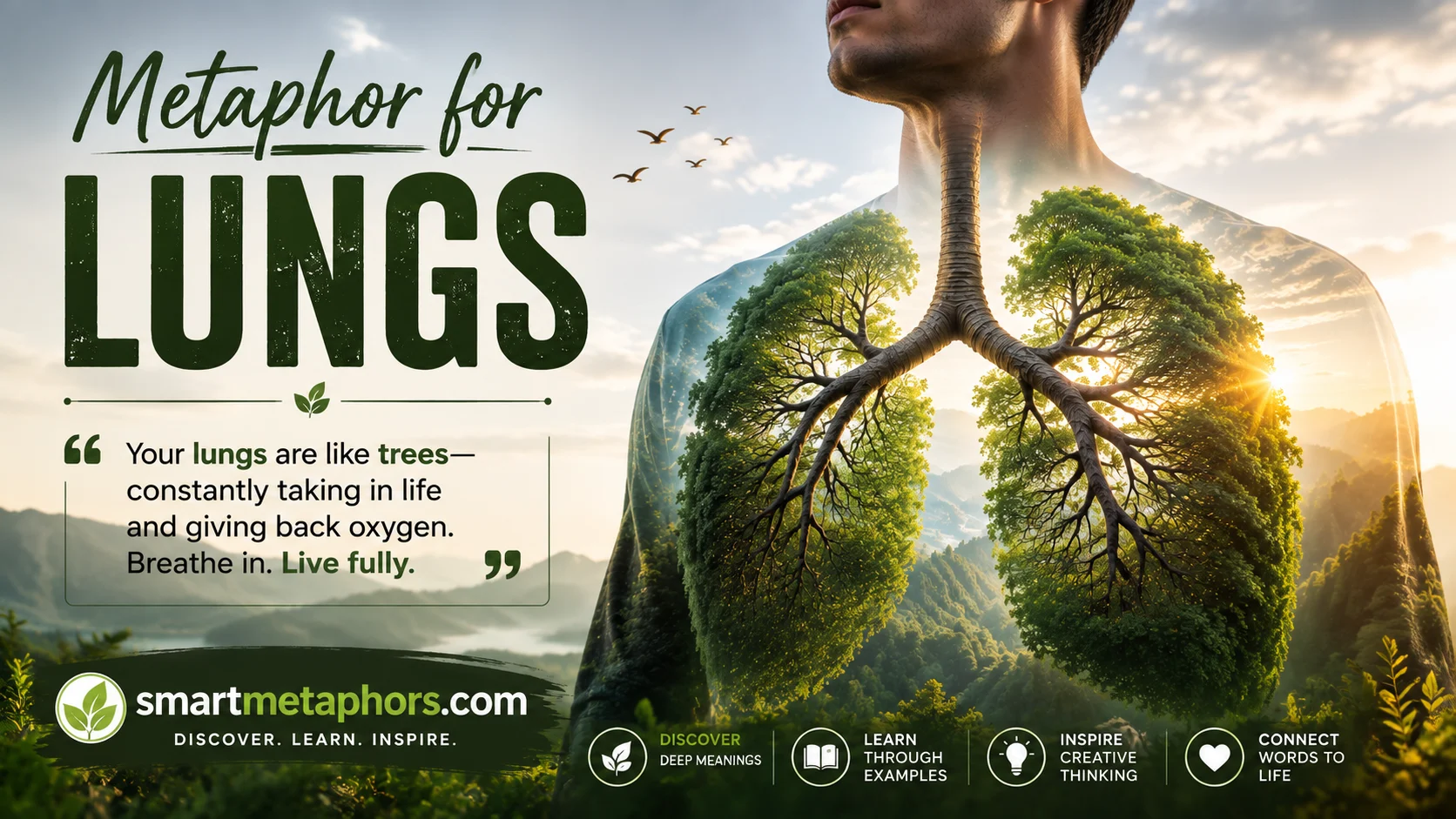
A metaphor for lungs can turn a simple description of breathing into vivid and meaningful imagery. Instead of describing lungs only as organs that take in oxygen, writers can portray them as bellows, sails, air chambers, or quiet engines that keep life moving.
These comparisons work especially well in poetry, fiction, essays, speeches, creative writing, and descriptive passages. Some metaphors focus on the physical action of breathing, while others use the lungs as symbols of freedom, vitality, endurance, or emotional release.
Key Takeaways
- Metaphors can make descriptions of lungs more vivid.
- Lungs can be compared to bellows, sails, engines, gardens, and other imagery.
- Different metaphors create different emotional effects.
- Physical, poetic, emotional, and scientific contexts call for different comparisons.
- The strongest metaphor matches the writer’s purpose and tone.
What Is a Metaphor?
Definition of a Metaphor
A metaphor directly describes one thing as another to create a meaningful comparison.
For example:
“The lungs are bellows for the body.”
Lungs are not literally bellows, but the comparison highlights how they move air in and out.
Why Use Metaphors for Lungs?
The word lungs can sound technical in ordinary writing. A metaphor adds imagery and helps readers imagine their function.
Compare:
Plain:
Her lungs filled with air.
Metaphorical:
Her lungs opened like sails catching the morning wind.
The second version creates movement and atmosphere.
How Metaphors Can Describe Lungs
Lungs can represent several ideas depending on the context:
- Breath
- Life
- Energy
- Freedom
- Movement
- Renewal
- Strength
- Vulnerability
- Emotional release
- Connection with nature
The same subject can therefore produce completely different metaphors depending on what the writer wants the reader to feel.
Creative Metaphors for Lungs
Nature-Inspired Metaphors for Lungs
The lungs are sails catching the wind
Meaning: The lungs take in air as sails catch wind.
Best Use: Describing deep or refreshing breaths.
Tone: Poetic
The lungs are two quiet gardens
Meaning: Suggests a living space where air moves and life is sustained.
Best Use: Nature-inspired poetry.
Tone: Peaceful
The lungs are forests breathing with the earth
Meaning: Connects human breathing with the natural world.
Best Use: Environmental and literary writing.
Tone: Reflective
The lungs are waves rising and falling
Meaning: Describes the steady rhythm of breathing.
Best Use: Calm or meditative scenes.
Tone: Serene
The lungs are clouds gathering air
Meaning: Creates an image of the lungs filling and expanding.
Best Use: Creative descriptions of inhalation.
Tone: Dreamy
The lungs are two hidden oceans
Meaning: Suggests depth, movement, and an unseen inner world.
Best Use: Poetry and introspective writing.
Tone: Mysterious
The lungs are leaves drinking the wind
Meaning: Presents breathing as a natural exchange with the air.
Best Use: Nature poetry.
Tone: Gentle
The lungs are roots reaching for breath
Meaning: Suggests that breathing is deeply connected to survival.
Best Use: Emotional writing.
Tone: Powerful
Powerful Metaphors for Lungs
The lungs are the body’s bellows
Meaning: Highlights the repeated movement of air.
Best Use: Educational or descriptive writing.
Tone: Strong and clear
The lungs are the engine room of breath
Meaning: Presents breathing as an essential process that keeps the body functioning.
Best Use: Informative writing.
Tone: Professional
The lungs are twin chambers of life
Meaning: Emphasizes their vital role in sustaining the body.
Best Use: Speeches and literary writing.
Tone: Dramatic
The lungs are silent workers
Meaning: Highlights how they work continuously without conscious attention.
Best Use: Reflective writing.
Tone: Thoughtful
The lungs are hidden furnaces of vitality
Meaning: Suggests an internal source of energy and life.
Best Use: Inspirational writing.
Tone: Powerful
The lungs are gates for the breath of life
Meaning: Portrays the lungs as an entrance through which life-sustaining air passes.
Best Use: Spiritual or poetic writing.
Tone: Profound
The lungs are the body’s air pumps
Meaning: Emphasizes their role in moving air.
Best Use: Simple educational writing.
Tone: Straightforward
The lungs are guardians of every breath
Meaning: Gives the lungs a protective and essential role.
Best Use: Emotional writing.
Tone: Serious
Poetic Metaphors for Lungs
The lungs are two wings beneath the ribs
Meaning: Creates an image of something expanding and contracting inside the chest.
Best Use: Poetry.
Tone: Elegant
The lungs are poems written in breath
Meaning: Connects breathing with rhythm and expression.
Best Use: Literary writing.
Tone: Artistic
The lungs are chambers where the wind sleeps
Meaning: Gives the lungs a mysterious inner quality.
Best Use: Poetry and fiction.
Tone: Dreamlike
The lungs are drums of invisible music
Meaning: The rhythm of breathing becomes a form of silent music.
Best Use: Creative writing.
Tone: Musical
The lungs are doors opening to the world
Meaning: Breath connects the inner body with the outside world.
Best Use: Philosophical writing.
Tone: Reflective
The lungs are lanterns filled with invisible light
Meaning: Suggests that breathing brings vitality into the body.
Best Use: Symbolic poetry.
Tone: Mystical
The lungs are rivers flowing beneath the ribs
Meaning: Presents breathing as a continuous inner movement.
Best Use: Descriptive poetry.
Tone: Flowing
The lungs are soft sails inside a human ship
Meaning: The body becomes a vessel powered by breath.
Best Use: Literary descriptions.
Tone: Imaginative
Simple Metaphors for Lungs
The lungs are air bags
Meaning: They fill and empty with air.
Best Use: Beginner writing.
Tone: Simple
The lungs are breath chambers
Meaning: Describes them as spaces that hold and move air.
Best Use: Student writing.
Tone: Clear
The lungs are body bellows
Meaning: Highlights their movement of air.
Best Use: Simple explanations.
Tone: Educational
The lungs are air-filled balloons
Meaning: Emphasizes expansion and contraction.
Best Use: Beginner-friendly descriptions.
Tone: Simple
The lungs are breathing machines
Meaning: Highlights their continuous work.
Best Use: Informal explanatory writing.
Tone: Direct
The lungs are the body’s sails
Meaning: Connects breathing with movement and life.
Best Use: Creative writing.
Tone: Poetic
The lungs are living pumps
Meaning: Emphasizes their active role in breathing.
Best Use: Educational writing.
Tone: Clear
Emotional Metaphors for Lungs
My lungs were prisons holding my fear
Meaning: Describes anxiety as something trapped inside the chest.
Best Use: Emotional fiction.
Tone: Dark
My lungs became doors to freedom
Meaning: Deep breathing represents relief or liberation.
Best Use: Inspirational writing.
Tone: Hopeful
My lungs were carrying the weight of the storm
Meaning: Suggests emotional heaviness affecting breathing.
Best Use: Dramatic fiction.
Tone: Emotional
My lungs were bursting with joy
Meaning: Extreme happiness creates an overwhelming physical feeling.
Best Use: Celebratory writing.
Tone: Joyful
My lungs were wells of courage
Meaning: Breath becomes a symbol of inner strength.
Best Use: Motivational writing.
Tone: Inspirational
My lungs were crowded with unsaid words
Meaning: Represents emotions or thoughts that have not been expressed.
Best Use: Poetry and introspective fiction.
Tone: Emotional
My lungs were drums beating against silence
Meaning: Breathing becomes a symbol of tension or emotional intensity.
Best Use: Dramatic scenes.
Tone: Intense
Metaphors for Lungs and Freedom
The lungs are sails for the human spirit
Meaning: Breathing becomes connected with freedom and movement.
Best Use: Inspirational writing.
Tone: Uplifting
The lungs are windows opened to the sky
Meaning: Suggests openness and freedom.
Best Use: Poetry.
Tone: Hopeful
The lungs are wings for an earthbound soul
Meaning: Breath gives the body a sense of freedom.
Best Use: Literary writing.
Tone: Profound
The lungs are open doors for the wind
Meaning: Represents unrestricted breathing and openness.
Best Use: Nature writing.
Tone: Peaceful
The lungs are sails on the sea of life
Meaning: Breath helps carry a person through life.
Best Use: Speeches and inspirational writing.
Tone: Inspirational
Metaphors for Lungs in Descriptive Writing
The lungs are two bellows beneath the ribs
Meaning: Creates a clear image of their physical location and movement.
Best Use: Descriptive fiction.
Tone: Vivid
The lungs are hidden chambers of air
Meaning: Focuses on their internal and unseen nature.
Best Use: General creative writing.
Tone: Mysterious
The lungs are the body’s breathing rhythm
Meaning: Emphasizes their connection to the steady pattern of respiration.
Best Use: Reflective descriptions.
Tone: Calm
The lungs are living reservoirs of breath
Meaning: Presents them as essential spaces associated with air.
Best Use: Poetry and prose.
Tone: Poetic
The lungs are twin vessels beneath the heart
Meaning: Creates a strong anatomical image without being overly technical.
Best Use: Literary descriptions.
Tone: Elegant
Funny and Creative Metaphors for Lungs
The lungs are two balloons with a full-time job
Meaning: Gives a humorous image of their constant work.
Best Use: Casual writing.
Tone: Funny
The lungs are nature’s air conditioners
Meaning: Uses playful machinery imagery for breathing.
Best Use: Humorous content.
Tone: Playful
The lungs are personal air pumps
Meaning: Turns an important body function into a simple mechanical image.
Best Use: Informal explanations.
Tone: Lighthearted
The lungs are two hardworking bellows
Meaning: Humorously emphasizes their nonstop activity.
Best Use: Casual creative writing.
Tone: Playful
Metaphor vs Simile
What Is a Metaphor?
A metaphor makes a direct comparison.
Example:
“The lungs are sails inside the body.”
What Is a Simile?
A simile compares two things using “like” or “as.”
Example:
“The lungs move like sails catching wind.”
Why the Difference Matters
Metaphors often sound stronger and more imaginative because they present the comparison directly.
Similes can make the relationship clearer for beginners because they openly signal the comparison.
How to Choose the Right Metaphor for Lungs
Think About the Purpose
Ask what you want the reader to notice.
If the focus is breathing, choose imagery such as:
- Bellows
- Pumps
- Sails
- Waves
If the focus is emotion, consider:
- Prisons
- Doors
- Drums
- Wells
Match the Tone
A scientific article needs clear imagery, while poetry can support more unusual comparisons.
Consider Your Audience
For children or students, simple metaphors such as “the lungs are balloons” are easy to understand.
For poetry, something such as “the lungs are poems written in breath” creates more emotional depth.
Expert Writing Tips
Give the Metaphor a Purpose
Don’t add a metaphor simply because it sounds beautiful. Make sure it communicates something meaningful about breathing, emotion, life, or movement.
Use Unexpected Connections
Fresh comparisons make writing memorable.
Instead of repeatedly comparing lungs to balloons, consider connecting them with sails, rivers, doors, or music.
Build Around One Image
If you begin with a sailing metaphor, continue developing that image.
For example:
“The lungs were sails, the ribs were their frame, and every breath was a new wind.”
The connected imagery feels more deliberate.
Use Sensory Language
Words connected to movement, sound, pressure, warmth, and air can make a lung metaphor feel more physical.
Common Mistakes to Avoid
Making the Metaphor Too Technical
A metaphor should make an idea easier to imagine, not turn it into a complicated scientific explanation.
Using the Same Comparison Repeatedly
Balloon and bellows metaphors are useful, but relying on them too often can make writing predictable.
Mixing Unrelated Images
Avoid jumping between sailing, cooking, machinery, and astronomy in one sentence unless there is a clear reason.
Ignoring the Emotional Context
A peaceful breathing scene needs different imagery from a tense or frightening scene.
Frequently Asked Questions
What is a metaphor for lungs?
A metaphor for lungs is a creative comparison that describes their function, movement, or symbolism. For example, “The lungs are the body’s bellows” emphasizes how they move air.
What are some creative metaphors for lungs?
Creative examples include “the lungs are sails,” “the lungs are poems written in breath,” “the lungs are twin chambers of life,” and “the lungs are waves rising and falling.”
What is a poetic metaphor for lungs?
A poetic metaphor could be “The lungs are two wings beneath the ribs.” It connects breathing with movement, freedom, and life.
What is a simple metaphor for lungs?
A simple metaphor is “The lungs are balloons.” It gives beginners an easy image for organs that expand and contract during breathing.
How can writers describe lungs creatively?
Writers can compare lungs to sails, bellows, rivers, wings, doors, gardens, or musical instruments depending on whether they want to emphasize breathing, movement, freedom, life, or emotion.
Can lungs be used as a metaphor for life?
Yes. Because breathing is closely connected with being alive, writers can use lungs as symbols of vitality, endurance, freedom, renewal, or the fragile nature of life.
Conclusion
A well-chosen metaphor for lungs can turn an ordinary description of breathing into something vivid and memorable. Lungs can become sails carrying the body forward, bellows sustaining a flame, wings beneath the ribs, or quiet chambers holding the rhythm of life.
The strongest metaphor depends on your purpose. Choose mechanical imagery when explaining function, natural imagery when describing beauty, and emotional imagery when exploring fear, freedom, relief, or vitality. When the comparison fits the context, even a simple description of the lungs can become powerful creative writing.

My Name is Alex Gard. I’m passionate about language, creative writing, and figurative expressions. Through SmartMetaphors, I help readers discover meaningful metaphors, similes, and literary devices to make their writing more engaging and impactful.