
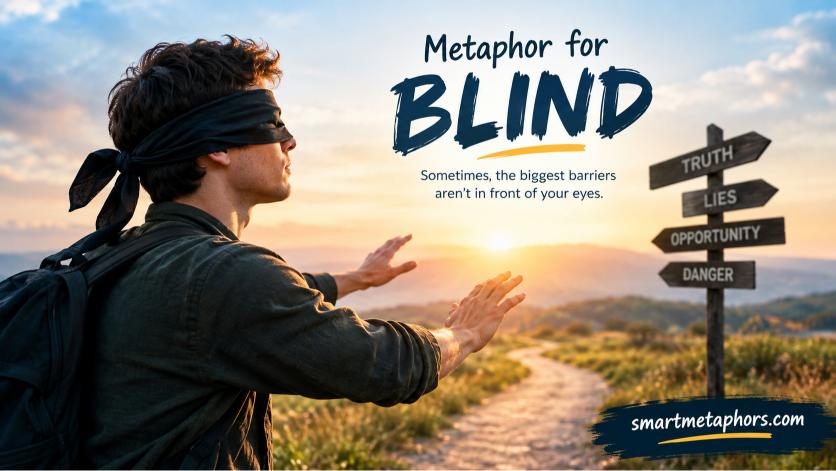
A metaphor for blind can give writers a powerful way to describe darkness, uncertainty, confusion, or a person’s inability to recognize something important.
Blindness can carry different meanings in figurative language. It may represent someone who cannot see the truth, refuses to notice reality, feels lost, or moves forward without knowing what lies ahead.
The most effective metaphor depends on the exact meaning you want to communicate. A closed door can suggest blocked understanding, while a traveler without a map can suggest uncertainty and lack of direction.
Key Takeaways
- Metaphors can describe blindness literally or figuratively.
- Blindness imagery can represent darkness, confusion, ignorance, or uncertainty.
- Different metaphors create different emotional effects.
- Context is important when choosing figurative language.
- Respectful wording matters when writing about disability.
- Strong metaphors should clarify an idea rather than simply replace the word “blind.”
What Is a Metaphor?
Definition of a Metaphor
A metaphor directly compares one thing with another to create a deeper meaning.
For example:
“He was a traveler without a map.”
The person is not literally a traveler. The metaphor suggests that he is uncertain and does not know which direction to take.
Why Writers Use Metaphors
Metaphors allow writers to communicate complex ideas through familiar images.
Instead of saying:
“She did not understand what was happening.”
A writer might say:
“She was standing in a room without windows.”
The image suggests isolation and a lack of understanding.
How Metaphors Express Blindness
The word “blind” can have several figurative meanings.
Blindness as Darkness
This focuses on the absence of light, visibility, or understanding.
Example:
“His thoughts were a moonless night.”
Blindness as Confusion
This focuses on being unable to find direction.
Example:
“He was a ship sailing without a compass.”
Blindness as Ignorance
This describes someone who does not recognize an important truth.
Example:
“The truth stood before him, but his mind was a locked door.”
Blindness as Emotional Unawareness
This describes someone who cannot recognize another person’s feelings or situation.
Example:
“Her heart was a window covered in frost.”
Metaphors for Blind
Metaphors for Darkness
A moonless night
Meaning: Complete darkness or lack of clarity.
Best Use: Poetry and atmospheric writing.
Tone: Poetic
A room without windows
Meaning: A situation where nothing can be clearly understood.
Best Use: Fiction and reflective writing.
Tone: Emotional
A sky without stars
Meaning: Darkness combined with a lack of guidance.
Best Use: Poetry.
Tone: Melancholic
A sunless morning
Meaning: A world that feels deprived of clarity or brightness.
Best Use: Descriptive writing.
Tone: Somber
A curtain over the world
Meaning: Something preventing clear perception.
Best Use: Literary writing.
Tone: Mysterious
An endless shadow
Meaning: Persistent darkness or uncertainty.
Best Use: Dramatic writing.
Tone: Dark
A lamp without a flame
Meaning: Something that exists but provides no illumination.
Best Use: Symbolic writing.
Tone: Thoughtful
A forest at midnight
Meaning: A confusing and difficult environment with little visibility.
Best Use: Storytelling.
Tone: Mysterious
Metaphors for Lack of Direction
A traveler without a map
Meaning: Someone who does not know where to go.
Best Use: Essays and storytelling.
Tone: Reflective
A ship without a compass
Meaning: Someone moving forward without guidance.
Best Use: Motivational and literary writing.
Tone: Serious
A road without signs
Meaning: A situation with no clear direction.
Best Use: Life-related writing.
Tone: Thoughtful
A pilot flying through clouds
Meaning: Moving forward without a clear view of what lies ahead.
Best Use: Describing uncertainty.
Tone: Dramatic
A compass spinning endlessly
Meaning: Unable to determine the correct direction.
Best Use: Emotional or reflective writing.
Tone: Uncertain
A train without tracks
Meaning: Movement without a reliable path.
Best Use: Creative writing.
Tone: Dramatic
A sailor lost at sea
Meaning: Feeling completely without direction.
Best Use: Poetry and fiction.
Tone: Emotional
A bird flying through fog
Meaning: Moving forward without knowing what is ahead.
Best Use: Nature-inspired writing.
Tone: Poetic
Metaphors for Lack of Understanding
A locked library
Meaning: Knowledge exists, but it cannot be accessed.
Best Use: Educational or literary writing.
Tone: Intellectual
A book written in an unknown language
Meaning: Something that cannot be understood.
Best Use: Describing confusion.
Tone: Thoughtful
A puzzle missing its picture
Meaning: Trying to understand something without enough information.
Best Use: Everyday writing.
Tone: Simple
A key without a lock
Meaning: Having something useful but not knowing how to apply it.
Best Use: Reflective writing.
Tone: Philosophical
A question without an answer
Meaning: A situation that remains unclear.
Best Use: Essays and poetry.
Tone: Serious
A window painted black
Meaning: Something blocks understanding or perception.
Best Use: Literary writing.
Tone: Symbolic
A signal buried in static
Meaning: An important message exists but cannot be understood clearly.
Best Use: Modern creative writing.
Tone: Contemporary
A puzzle covered in fog
Meaning: A problem that cannot yet be understood.
Best Use: Fiction and essays.
Tone: Mysterious
Metaphors for Ignoring the Truth
A closed door facing the truth
Meaning: Someone refuses to recognize reality.
Best Use: Serious writing.
Tone: Direct
A mirror turned toward the wall
Meaning: Refusing to look at reality or oneself.
Best Use: Psychological or literary writing.
Tone: Reflective
A curtain drawn over reality
Meaning: Something prevents a person from recognizing the truth.
Best Use: Essays and fiction.
Tone: Dramatic
A window refusing the sunrise
Meaning: Deliberately avoiding awareness.
Best Use: Poetry.
Tone: Poetic
An ear buried in silence
Meaning: Refusing to listen to obvious information.
Best Use: Figurative descriptions of stubbornness.
Tone: Serious
A mind behind a wall
Meaning: A person is unable or unwilling to see beyond their current beliefs.
Best Use: Reflective writing.
Tone: Thoughtful
A lighthouse facing the wrong direction
Meaning: Having the ability to guide but failing to recognize what matters.
Best Use: Fiction and essays.
Tone: Symbolic
Poetic Metaphors for Blindness
A night carrying no stars
Meaning: A profound absence of clarity or hope.
Best Use: Poetry.
Tone: Melancholic
A dream without a horizon
Meaning: A vision that has no clear direction.
Best Use: Literary writing.
Tone: Poetic
A silent world behind velvet curtains
Meaning: Separation from what is happening outside.
Best Use: Fiction.
Tone: Mysterious
A river flowing beneath darkness
Meaning: Life continuing even when its path cannot be seen.
Best Use: Poetry.
Tone: Reflective
A candle swallowed by night
Meaning: Light or understanding overwhelmed by darkness.
Best Use: Dramatic poetry.
Tone: Powerful
A star hidden behind clouds
Meaning: Something valuable exists but cannot currently be perceived.
Best Use: Hopeful writing.
Tone: Gentle
A garden growing behind a wall
Meaning: Beauty or knowledge exists beyond someone’s awareness.
Best Use: Symbolic writing.
Tone: Hopeful
A sunrise hidden beneath the horizon
Meaning: Something is present but has not yet become visible.
Best Use: Inspirational writing.
Tone: Optimistic
Simple Metaphors for Beginners
A dark room
Meaning: Lack of clarity.
A closed window
Meaning: Blocked perception.
A lost traveler
Meaning: Lack of direction.
A foggy road
Meaning: Uncertainty.
A covered mirror
Meaning: Inability to recognize reality.
A silent compass
Meaning: Lack of guidance.
A hidden path
Meaning: An unclear direction.
A clouded sky
Meaning: Limited clarity.
Metaphor vs Simile
What Is a Metaphor?
A metaphor makes a direct comparison.
Metaphor:
“His mind was a locked room.”
What Is a Simile?
A simile uses “like” or “as” to make a comparison.
Simile:
“His mind was like a locked room.”
Why the Difference Matters
A metaphor often sounds more direct and powerful, while a simile makes the comparison more explicit.
Both can describe blindness, uncertainty, darkness, or lack of awareness effectively.
How to Choose the Right Metaphor for Blind
Decide What “Blind” Means
First identify the idea you are actually describing.
Are you referring to:
- Physical darkness?
- Confusion?
- Ignorance?
- Emotional unawareness?
- Refusal to accept the truth?
- Lack of direction?
Your answer should determine the metaphor.
Match the Emotional Tone
A peaceful metaphor such as “a star hidden behind clouds” creates a very different feeling from “a candle swallowed by night.”
Choose imagery that supports the mood.
Consider Your Audience
For students, simple comparisons are usually easier to understand.
For poetry or fiction, you can use more layered imagery.
Be Precise
A metaphor should communicate something specific.
Instead of using darkness simply because it sounds dramatic, ask what kind of darkness you want the reader to imagine.
Expert Writing Tips
Use Specific Imagery
Rather than saying:
“He was blind to the situation.”
Try:
“The truth stood before him like an unopened letter.”
This gives the reader something concrete to imagine.
Avoid Treating Blindness as a Character Flaw
When writing about actual blindness or visual disability, be careful with language. Blindness is a real sensory disability, so avoid automatically equating it with stupidity, weakness, or moral failure.
For figurative writing, make sure the metaphor clearly refers to lack of awareness, understanding, or direction when that is what you mean.
Make the Comparison Fit the Context
A metaphor in a poem can be highly imaginative. A metaphor in an academic essay should usually be clearer and more controlled.
Create Fresh Comparisons
Think about what blocks visibility in real life:
- Fog
- Curtains
- Walls
- Darkness
- Clouds
- Closed doors
- Distance
- Smoke
Then connect those physical barriers to the abstract idea you want to express.
Common Mistakes to Avoid
Using “Blind” as a Shortcut for Insult
If you mean someone is careless or ignorant, consider using a metaphor that specifically communicates lack of awareness rather than using blindness as an insult.
Choosing a Metaphor That Is Too Vague
“He was darkness” may sound dramatic but does not tell the reader what kind of blindness you mean.
Mixing Too Many Images
Avoid moving from a foggy road to a locked library to a burning ocean in one short passage.
Choose one central image and develop it.
Making Every Metaphor Negative
Blindness-related imagery can also represent mystery, inward reflection, uncertainty, or discovering a new perspective.
Frequently Asked Questions
What is a metaphor for blind?
A metaphor for blind can be “a traveler without a map,” “a closed window,” “a room without windows,” or “a bird flying through fog.” The best choice depends on whether you mean darkness, uncertainty, or lack of awareness.
What is a good metaphor for being blind to the truth?
“A mirror turned toward the wall” is a strong metaphor for someone who refuses to recognize or confront the truth.
How do you describe blindness creatively?
You can use imagery involving darkness, fog, closed doors, covered windows, hidden paths, or missing light to express different forms of blindness.
What is a metaphor for not seeing something clearly?
“A bird flying through fog” works well because it suggests movement without a clear view of what lies ahead.
Can blindness be used as a metaphor in writing?
Yes, but context matters. When referring to a real visual disability, respectful and precise language is important. For figurative writing, it is often clearer to identify the specific idea—such as confusion, ignorance, or lack of awareness—that you want the metaphor to express.
Conclusion
A metaphor for blind can communicate much more than physical darkness. It can represent uncertainty, confusion, limited understanding, emotional unawareness, or the refusal to recognize reality.
The strongest metaphor depends on the exact idea behind the word. A traveler without a map suggests uncertainty, a closed window suggests blocked perception, and a mirror turned toward the wall suggests avoiding the truth.
When you choose imagery that matches your meaning, tone, and audience, your writing becomes clearer, more memorable, and more powerful.

My Name is Alex Gard. I’m passionate about language, creative writing, and figurative expressions. Through SmartMetaphors, I help readers discover meaningful metaphors, similes, and literary devices to make their writing more engaging and impactful.