
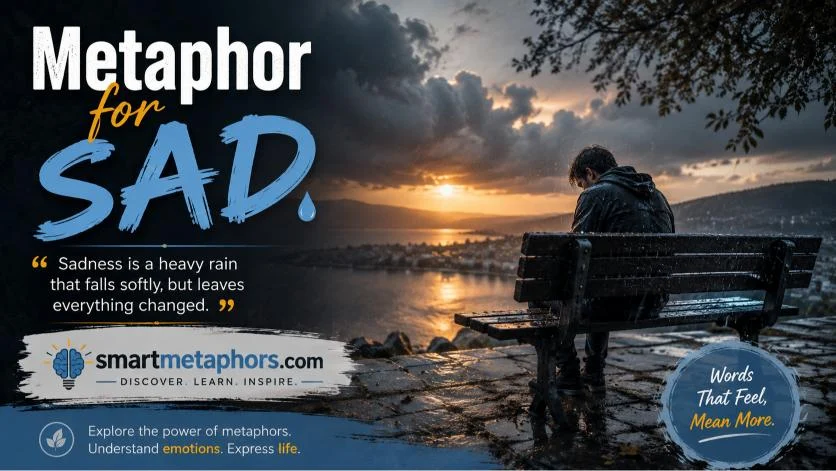
A metaphor for sad can turn a simple feeling into an image that readers can see and feel. Instead of writing, “He was sad,” you might say, “His heart was an abandoned house.” The metaphor immediately suggests emptiness, loneliness, and emotional loss.
Sadness can be quiet, overwhelming, temporary, or deeply painful. Because of this, the best metaphor depends on the kind of sadness you want to express.
Whether you’re writing a poem, story, essay, caption, speech, or personal reflection, these creative metaphors can help you express sadness with greater emotional depth.
Key Takeaways
- Metaphors make sadness more vivid and emotional.
- Different images can represent different forms of sadness.
- Rain, darkness, winter, empty rooms, and fading light can symbolize sorrow.
- The strongest metaphors match the emotional situation.
- Original comparisons are often more memorable than common clichés.
- A good metaphor should create an image without making the meaning confusing.
What Is a Metaphor?
Simple Definition
A metaphor is a figure of speech that describes one thing as another to create a deeper meaning.
For example:
“Her sadness was a winter.”
She is not literally experiencing winter. The comparison suggests coldness, emptiness, and a lack of warmth or happiness.
Why Metaphors Are Powerful
Saying someone is sad tells the reader what happened.
A metaphor shows the reader what that sadness feels like.
Compare:
Simple:
“He felt lonely.”
Metaphorical:
“He was an island surrounded by silence.”
The second sentence creates a much stronger emotional picture.
How Metaphors Express Sadness
Sadness has many forms, so different metaphors can communicate different emotions.
Quiet Sadness
Use gentle imagery such as:
- Fading light
- Empty rooms
- Falling leaves
- Distant rain
Deep Emotional Pain
Use stronger imagery such as:
- Cracked glass
- Storm clouds
- Heavy oceans
- Broken bridges
Loneliness
Use images of separation, emptiness, and distance.
Heartbreak
Use imagery involving broken objects, disappearing light, abandoned places, or unfinished stories.
Creative Metaphors for Sad
Everyday Metaphors for Sadness
My heart was a rainy window.
Meaning: Sadness clouds the person’s emotional view of the world.
Best Use: General sadness and reflective writing.
Tone: Emotional
His smile was a fading photograph.
Meaning: Happiness was disappearing.
Best Use: Fiction and personal writing.
Tone: Melancholic
Her mind was a room without windows.
Meaning: She felt trapped inside her sadness.
Best Use: Emotional storytelling.
Tone: Heavy
My happiness was a candle running out of wax.
Meaning: Joy was gradually disappearing.
Best Use: Personal reflection.
Tone: Poetic
His heart was an empty chair.
Meaning: Someone or something important was missing.
Best Use: Writing about loss.
Tone: Sad
Her thoughts were gray clouds.
Meaning: Negative thoughts filled her mind.
Best Use: Simple descriptive writing.
Tone: Somber
My spirit was a wilting flower.
Meaning: Emotional energy and happiness were fading.
Best Use: Poetry and reflective writing.
Tone: Gentle
His laughter was a distant echo.
Meaning: Happiness felt far away.
Best Use: Nostalgic writing.
Tone: Melancholic
Powerful Metaphors for Deep Sadness
My heart was a house after the storm.
Meaning: Emotional devastation remained after a painful experience.
Best Use: Heartbreak or major loss.
Tone: Dramatic
Her soul was a cracked mirror.
Meaning: Emotional pain had changed how she saw herself or her life.
Best Use: Literary writing.
Tone: Dark
My sadness was an ocean with no shore.
Meaning: The sadness felt endless.
Best Use: Deep emotional writing.
Tone: Powerful
His grief was an anchor around his heart.
Meaning: Pain prevented him from moving forward.
Best Use: Writing about grief or loss.
Tone: Serious
Her heart was a sky without stars.
Meaning: Hope and happiness seemed completely absent.
Best Use: Poetry and fiction.
Tone: Dramatic
My memories were thorns in a garden.
Meaning: Beautiful memories were mixed with emotional pain.
Best Use: Nostalgic or heartbreak writing.
Tone: Emotional
His sadness was a locked ocean.
Meaning: Deep emotions were trapped inside him.
Best Use: Characters who hide their feelings.
Tone: Mysterious
Her hope was a bridge collapsing behind her.
Meaning: She felt that returning to happiness was becoming impossible.
Best Use: Dramatic storytelling.
Tone: Intense
Funny Metaphors for Sadness
Not every expression of sadness has to be serious. Humor can describe mild disappointment or exaggerated sadness.
My mood was a Wi-Fi signal in a basement.
Meaning: The person’s emotional energy was extremely low.
Best Use: Social media and casual conversation.
Tone: Funny
My happiness was a phone at one percent.
Meaning: Very little happiness remained.
Best Use: Casual captions.
Tone: Playful
My face was a rainy Monday.
Meaning: The person looked extremely unhappy.
Best Use: Humorous writing.
Tone: Funny
My motivation was a forgotten password.
Meaning: Motivation seemed impossible to find.
Best Use: Relatable social media content.
Tone: Lighthearted
My mood was a broken umbrella.
Meaning: Even the thing meant to provide protection was failing.
Best Use: Casual writing.
Tone: Quirky
Romantic Metaphors for Sadness
My heart was an unfinished love letter.
Meaning: Feelings remained unresolved.
Best Use: Romantic poetry and heartbreak.
Tone: Romantic
Your absence was winter in my chest.
Meaning: Losing someone created emotional coldness.
Best Use: Love poems.
Tone: Poetic
Our love was a fading sunset.
Meaning: A relationship was slowly coming to an end.
Best Use: Romantic storytelling.
Tone: Melancholic
My heart was a garden after autumn.
Meaning: Something beautiful had passed away or disappeared.
Best Use: Breakup writing.
Tone: Emotional
Your goodbye was a door closing on summer.
Meaning: The relationship’s happiness ended suddenly.
Best Use: Romantic poetry.
Tone: Nostalgic
My memories of you were photographs in the rain.
Meaning: Beautiful memories had become painful and blurred by sadness.
Best Use: Heartbreak writing.
Tone: Poetic
Nature-Inspired Metaphors for Sadness
Sadness was a forest beneath a gray sky.
Meaning: Sorrow surrounded the person completely.
Best Use: Descriptive fiction.
Tone: Atmospheric
My heart was a leaf falling from autumn.
Meaning: Something was coming to an unavoidable end.
Best Use: Reflective writing.
Tone: Gentle
Her hope was a flower beneath winter.
Meaning: Hope existed but could not flourish.
Best Use: Emotional poetry.
Tone: Symbolic
His grief was a river running underground.
Meaning: Sadness remained hidden beneath the surface.
Best Use: Character development.
Tone: Subtle
My emotions were waves beneath a dark moon.
Meaning: Powerful feelings moved beneath a quiet exterior.
Best Use: Poetry.
Tone: Mysterious
Her heart was a garden without spring.
Meaning: Happiness and renewal never seemed to arrive.
Best Use: Deep sadness.
Tone: Poetic
Literary and Poetic Metaphors for Sadness
My sorrow was ink that never dried.
Meaning: The pain remained fresh.
Best Use: Poetry and literary fiction.
Tone: Literary
My heart was a book missing its final chapter.
Meaning: Something important remained unfinished.
Best Use: Loss and heartbreak.
Tone: Reflective
Silence was the language of my grief.
Meaning: The person could not express their pain through ordinary words.
Best Use: Emotional writing.
Tone: Profound
My sadness was a shadow stitched to my feet.
Meaning: Sorrow followed the person everywhere.
Best Use: Literary fiction.
Tone: Dark
Hope was a distant star behind clouds.
Meaning: Hope still existed but could not be clearly seen.
Best Use: Inspirational or emotional writing.
Tone: Hopeful
My memories were ghosts in an empty house.
Meaning: The past continued to haunt the person.
Best Use: Grief and nostalgia.
Tone: Haunting
My tears were letters my heart could not send.
Meaning: Tears expressed feelings that words could not communicate.
Best Use: Poetry and emotional captions.
Tone: Tender
Short and Simple Metaphors for Sad
My heart was rain.
Meaning: Deep sadness.
Best Use: Simple poetry.
Tone: Poetic
My soul was winter.
Meaning: Emotional coldness and emptiness.
Best Use: Creative writing.
Tone: Somber
My smile was a mask.
Meaning: Happiness was being hidden.
Best Use: Personal writing.
Tone: Serious
My hope was a candle.
Meaning: A small amount of hope remained.
Best Use: Inspirational writing.
Tone: Gentle
My heart was a storm.
Meaning: Strong emotions were overwhelming.
Best Use: Poetry and fiction.
Tone: Dramatic
Metaphor vs Simile
What Is a Metaphor?
A metaphor makes a direct comparison.
“Her sadness was winter.”
What Is a Simile?
A simile uses “like” or “as” to make a comparison.
“Her sadness was like winter.”
Side-by-Side Examples
Metaphor:
“My heart was an empty house.”
Simile:
“My heart felt like an empty house.”
Metaphor:
“His grief was an anchor.”
Simile:
“His grief was like an anchor.”
Metaphors usually sound more direct and confident, while similes can make comparisons feel softer and more conversational.
How to Choose the Right Metaphor for Sadness
Think About the Type of Sadness
Ask yourself what the character or speaker actually feels.
Is it:
- Loneliness?
- Grief?
- Disappointment?
- Heartbreak?
- Regret?
- Emotional exhaustion?
- Nostalgia?
The answer should guide your imagery.
Match the Emotional Intensity
For mild sadness, use gentle imagery:
“My mood was a cloudy morning.”
For intense sadness, choose stronger imagery:
“My grief was an ocean with no shore.”
Consider Your Audience
Simple metaphors work well for students and general readers.
More layered metaphors work better for poetry, novels, and literary essays.
Match the Tone
A humorous metaphor belongs in casual writing.
A serious metaphor belongs in emotional storytelling.
Expert Writing Tips
Show the Emotion Instead of Naming It
Instead of:
“She was very sad.”
Try:
“Her smile became a photograph of happier days.”
The reader discovers the sadness through imagery.
Build Metaphors From the Situation
The strongest metaphors often come directly from the scene.
If your character is standing alone at a train station, you might write:
“The empty platform was a mirror of her heart.”
The setting and emotion reinforce each other.
Use Contrasting Images
Sadness becomes more powerful when it contrasts with happiness.
For example:
“The room was full of sunlight, but her heart was winter.”
The bright setting makes the emotional darkness more noticeable.
Don’t Explain Everything
Let the image carry some of the meaning.
A strong metaphor should give the reader something to interpret.
Common Mistakes to Avoid
Using the Same Rain Metaphor Repeatedly
Rain is strongly associated with sadness, but using it too often can make your writing predictable.
Try alternatives such as:
- An abandoned house
- A fading photograph
- A locked door
- A dying candle
- A winter garden
Making the Metaphor Too Complicated
A metaphor should create an image, not require a paragraph of explanation.
Choosing the Wrong Emotional Image
A playful metaphor may not fit a scene about serious grief.
Always consider the emotional weight of the situation.
Mixing Metaphors
Avoid sentences such as:
“Her sadness was an ocean that climbed a mountain and opened a locked door.”
The images compete with one another.
Choose one strong central image instead.
Frequently Asked Questions
What is a metaphor for sad?
A metaphor for sad describes sadness through a direct comparison, such as “Her heart was an empty house.” It creates emotional imagery instead of simply stating that someone is sad.
What are some powerful metaphors for sadness?
Powerful examples include “My sadness was an ocean with no shore,” “Her heart was a sky without stars,” and “His grief was an anchor around his heart.”
How do you describe sadness creatively?
Use images connected to emptiness, darkness, distance, fading light, winter, storms, abandoned places, or broken objects. Choose imagery that matches the type and intensity of sadness.
What is a metaphor for a broken heart?
A strong metaphor for a broken heart is “My heart was a shattered window.” It suggests emotional damage, vulnerability, and pain.
What is the difference between a sad metaphor and a simile?
A sad metaphor makes a direct comparison, such as “Her heart was winter.” A simile uses “like” or “as,” such as “Her heart was like winter.”
How can writers show sadness without saying sad?
Writers can use actions, settings, sensory details, and metaphors. For example, “His laughter was a distant echo” suggests sadness without directly naming the emotion.
What is a metaphor for loneliness?
“I was an island in a crowded sea” is a metaphor for loneliness. It suggests being emotionally isolated even when surrounded by other people.
Conclusion
A well-chosen metaphor for sad can turn an ordinary emotional statement into vivid, memorable writing. Instead of simply telling readers that someone feels sorrow, metaphors allow them to experience that emotion through images of rain, winter, empty houses, fading light, storms, and distant stars.
The most effective metaphor depends on the kind of sadness you’re describing. A quiet sadness may need a fading candle, while deep heartbreak might call for a shattered window or an ocean with no shore.
When you match your metaphor to the emotion, audience, and context, even a simple sentence can carry remarkable emotional power.

My Name is Alex Gard. I’m passionate about language, creative writing, and figurative expressions. Through SmartMetaphors, I help readers discover meaningful metaphors, similes, and literary devices to make their writing more engaging and impactful.