
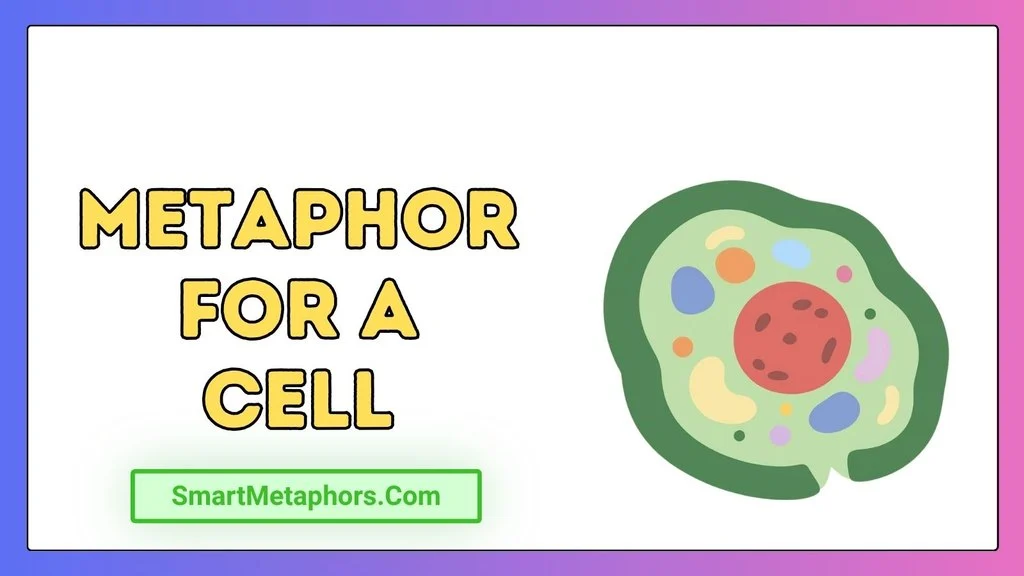
A metaphor for a cell can make a complex biological idea much easier to understand. Instead of describing a cell only with scientific terms, you can compare it to a city, factory, school, machine, or even a tiny world.
These comparisons are especially useful for students, teachers, science writers, and anyone trying to explain biology in simple language.
In this guide, you’ll find creative cell metaphors, explanations of what they mean, examples of how to use them, and tips for choosing the right comparison.
Key Takeaways
- A cell can be compared to many familiar systems.
- Different metaphors explain different cellular functions.
- A city metaphor is useful for explaining how cell organelles work together.
- A factory metaphor emphasizes production and energy.
- A fortress metaphor focuses on protection and boundaries.
- Metaphors simplify science without replacing accurate scientific explanations.
What Is a Metaphor for a Cell?
Simple Definition
A metaphor for a cell directly compares a cell to something familiar.
For example:
“The cell is a tiny factory.”
A cell is not literally a factory. The comparison helps explain how different parts of a cell perform specialized jobs.
Why Use Metaphors in Biology?
Biology contains many complex structures and processes. Metaphors give learners something familiar to connect with those ideas.
For example:
- Cell membrane → security gate
- Nucleus → control center
- Mitochondria → power stations
- Ribosomes → manufacturing machines
- Golgi apparatus → packaging department
The metaphor provides an easy mental picture while the scientific explanation provides the actual information.
Creative Metaphors for a Cell
A Tiny City
Meaning: A cell contains many specialized structures that work together, much like different parts of a city.
Best Use: Biology lessons and school assignments.
Tone: Educational
A Microscopic Factory
Meaning: A cell carries out many organized processes to produce, process, and transport materials.
Best Use: Explaining cellular organization.
Tone: Scientific and simple
A Miniature World
Meaning: A cell contains its own complex environment with structures performing different functions.
Best Use: Creative science writing.
Tone: Imaginative
A Living Machine
Meaning: The cell contains coordinated parts that perform essential biological functions.
Best Use: Introductory biology explanations.
Tone: Educational
A Busy Workshop
Meaning: Many cellular processes happen continuously and simultaneously.
Best Use: Explaining active cells.
Tone: Simple
A Tiny Power Plant
Meaning: The cell produces and manages energy needed for its activities.
Best Use: Explaining mitochondria and cellular energy.
Tone: Educational
A Fortress of Life
Meaning: The cell has protective structures that separate its internal environment from the outside.
Best Use: Explaining the cell membrane and cell wall.
Tone: Dramatic
A Command Center
Meaning: The nucleus contains genetic information and plays a major role in regulating cellular activity.
Best Use: Explaining the nucleus.
Tone: Clear and scientific
A Library of Instructions
Meaning: DNA stores biological instructions used by the cell.
Best Use: Explaining genetic information.
Tone: Educational
A Recipe Book
Meaning: Genetic information provides instructions for making proteins and carrying out cellular functions.
Best Use: Explaining DNA to beginners.
Tone: Simple
Metaphors for Different Parts of a Cell
The Nucleus as a Control Room
The nucleus can be described as the control room of the cell because it contains genetic material and helps regulate many cellular activities.
The Cell Membrane as a Security Gate
The cell membrane can be compared to a security gate because it controls what enters and leaves the cell.
Mitochondria as Power Stations
Mitochondria can be described as power stations because they are central to the production of usable cellular energy.
Ribosomes as Assembly Lines
Ribosomes can be compared to assembly lines because they build proteins.
The Golgi Apparatus as a Post Office
The Golgi apparatus can be described as a post office because it modifies, sorts, and packages certain cellular materials for delivery.
The Endoplasmic Reticulum as a Transport Network
The endoplasmic reticulum can be compared to a transportation network because it helps move materials within the cell.
Lysosomes as Recycling Centers
Lysosomes can be compared to recycling centers because they break down certain materials and cellular waste.
Cytoplasm as a Busy Workplace
The cytoplasm can be imagined as a busy workplace where many cellular activities occur.
Nature-Inspired Cell Metaphors
A Living Ecosystem
This metaphor emphasizes how different parts interact within the cell.
A Microscopic Forest
This comparison can make the internal environment of a cell feel alive and interconnected.
A Drop of Life
This metaphor focuses on how a tiny cell can contain the essential machinery needed for life.
A Seed of Existence
This metaphor emphasizes growth, potential, and biological development.
A Living Ocean
This comparison highlights the fluid environment in which cellular structures operate.
Machine-Based Cell Metaphors
A Precision Engine
This emphasizes coordinated biological processes.
A Self-Running Machine
This highlights the cell’s ability to carry out many processes independently.
A Biological Computer
This can describe the way cells store, process, and use biological information.
A Programmable Workshop
This metaphor connects genetic instructions with cellular activity.
A Network of Machines
This emphasizes how different organelles perform specialized jobs while working together.
School-Friendly Metaphors for a Cell
A Classroom
Different parts of the cell can be compared to people with different responsibilities.
A School Building
Different rooms can represent different organelles and their functions.
A School Principal’s Office
The nucleus can be compared to the principal’s office because it plays a major role in organization and control.
A School Cafeteria
This can help explain how materials are processed and distributed.
A School Security System
This is useful for explaining how the cell membrane controls access.
Funny and Creative Cell Metaphors
A Tiny Office With No Lunch Break
This highlights the constant activity inside cells.
A Microscopic Busy City
This creates a fun image of organelles constantly performing their jobs.
A Biological Office Building
Each organelle becomes a specialized department.
A Tiny Factory That Never Sleeps
This emphasizes continuous cellular activity.
A Pocket-Sized Universe
This metaphor highlights the complexity hidden inside something incredibly small.
Literary and Poetic Cell Metaphors
A Universe Behind a Membrane
This emphasizes the enormous complexity contained within a microscopic boundary.
A Symphony of Life
Different cellular components work together like instruments in a musical performance.
A Hidden Kingdom
This presents the cell as a small but organized world.
A Drop Carrying a Universe
This highlights the remarkable complexity of microscopic life.
A Secret Garden of Life
This metaphor creates an image of a hidden, living environment.
How to Choose the Right Metaphor for a Cell
Match the Metaphor to the Concept
Choose the comparison based on what you want to explain.
For organization, use:
“The cell is a city.”
For energy:
“The mitochondria are power stations.”
For genetic information:
“DNA is an instruction manual.”
Consider Your Audience
For young students, simple metaphors such as factory, school, and city are easier to understand.
For advanced learners, metaphors involving networks, information systems, and biological machines may be more useful.
Keep Scientific Accuracy in Mind
A metaphor should simplify a concept without creating a false scientific idea.
For example, calling mitochondria powerhouses is useful, but it should not suggest that they literally generate energy from nothing.
Metaphor vs Simile
What Is a Metaphor?
A metaphor makes a direct comparison.
“The cell is a tiny factory.”
What Is a Simile?
A simile uses “like” or “as.”
“The cell is like a tiny factory.”
Which One Is Better for Science Writing?
Both can be useful.
Metaphors are often more direct and memorable, while similes can make it clearer that the comparison is only an analogy.
Expert Writing Tips
Explain the Comparison
Don’t simply write:
“A cell is a city.”
Explain why:
“A cell is a city because its different organelles perform specialized jobs that keep the entire system functioning.”
Choose Familiar Objects
The strongest educational metaphors usually compare unfamiliar scientific concepts with things students already understand.
Don’t Stretch the Metaphor Too Far
A metaphor is a teaching tool, not a complete scientific model.
Use it to introduce an idea, then provide the accurate biological explanation.
Use One Central Metaphor
If you’re writing a school assignment, keeping one consistent metaphor can make the explanation easier to follow.
For example, if the cell is a city, you can describe the nucleus as the city hall, the membrane as the city border, and mitochondria as power stations.
Common Mistakes to Avoid
Making the Metaphor Too Complicated
A complicated metaphor can make biology harder rather than easier.
Treating the Metaphor as Literal
Remember that a cell isn’t actually a city, factory, or machine.
Ignoring Scientific Accuracy
Always make sure the real biological function supports the comparison.
Mixing Too Many Metaphors
Switching between a city, spaceship, school, and factory in the same explanation can confuse readers.
Frequently Asked Questions
What is a metaphor for a cell?
A metaphor for a cell is a comparison that explains cellular structure or function using something familiar. A common example is “A cell is a tiny city.”
What is a good metaphor for a cell?
“A cell is a tiny factory” is a useful metaphor because it shows how different parts perform specialized tasks that keep the cell functioning.
What is a metaphor for a cell membrane?
A cell membrane can be described as a security gate because it controls what enters and leaves the cell.
What is a metaphor for the nucleus?
The nucleus can be described as a command center because it contains DNA and plays an important role in regulating cellular activities.
What is a metaphor for mitochondria?
Mitochondria can be described as power stations because they are central to the cell’s energy-producing processes.
What is a metaphor for DNA?
DNA can be described as an instruction manual because it contains genetic information used by cells to build proteins and regulate biological processes.
Why are cell metaphors useful for students?
Cell metaphors connect unfamiliar biological concepts with familiar objects and systems, making difficult ideas easier to visualize and remember.
Conclusion
A metaphor for a cell can turn an abstract biology lesson into something much easier to visualize. Comparing a cell to a city, factory, machine, fortress, or tiny universe gives readers a familiar framework for understanding its complex organization.
The most effective metaphor depends on what you want to explain. Use a city for organization, a factory for production, a power station for energy, a security gate for the cell membrane, and an instruction manual for DNA.
When used carefully, metaphors don’t replace scientific knowledge—they provide a memorable bridge to understanding it.

My Name is Alex Gard. I’m passionate about language, creative writing, and figurative expressions. Through SmartMetaphors, I help readers discover meaningful metaphors, similes, and literary devices to make their writing more engaging and impactful.