
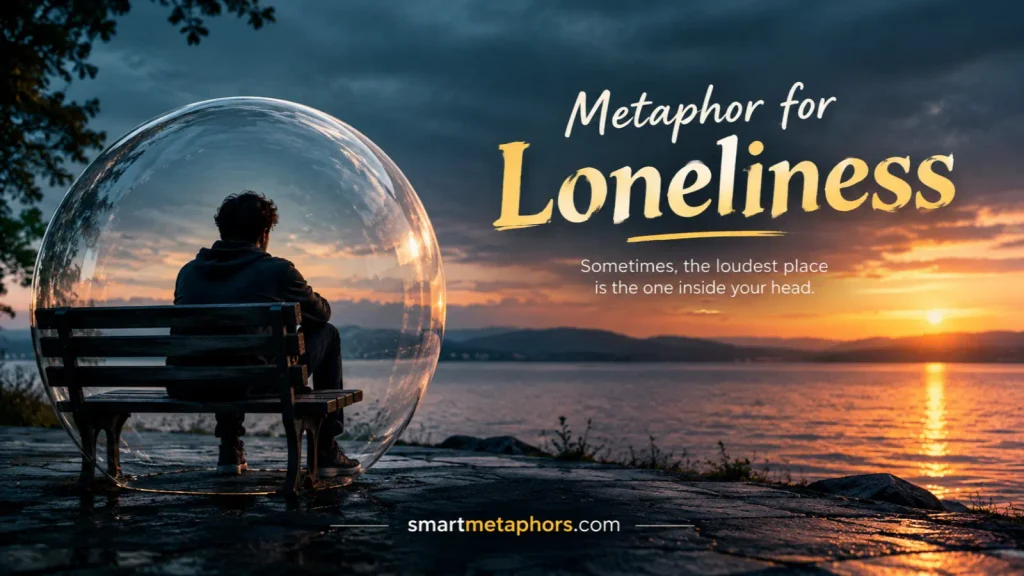
A metaphor for loneliness can turn a quiet, difficult emotion into an image that readers can see and feel. Loneliness is not always about having nobody nearby. Sometimes, it means feeling invisible in a crowded room, missing someone who once mattered, or carrying feelings that nobody seems to understand.
Writers use metaphors to give this hidden emotion a voice. An empty house can represent a heart without connection, while a bird flying alone through a winter sky can symbolize isolation and longing.
Whether you’re writing poetry, a story, a personal essay, a song, or a social media caption, the right metaphor can help you express loneliness with greater depth and originality.
Key Takeaways
- Loneliness metaphors turn difficult emotions into vivid images.
- Different comparisons express sadness, isolation, longing, or independence.
- Strong metaphors show the experience of loneliness instead of simply naming it.
- The best metaphor depends on the situation, audience, and emotional tone.
- Original imagery can make emotional writing more personal and memorable.
What Is a Metaphor for Loneliness?
Definition of a Loneliness Metaphor
A metaphor is a figure of speech that describes one thing as another to create a deeper meaning.
For example:
My heart was an abandoned house.”
The heart is not literally a house. The image suggests that affection, warmth, and companionship are missing.
How Metaphors Express Loneliness
Loneliness can take many forms. It may feel like being forgotten, losing an important connection, or struggling to communicate with others.
Metaphors help express these differences through familiar images:
- An empty room represents emotional emptiness.
- A distant island represents separation.
- A fading candle represents hope growing weaker.
- A locked door represents difficulty letting others in.
- A solitary tree represents standing alone in the world.
Each image gives loneliness a different emotional meaning.
Powerful Metaphors for Loneliness
These metaphors focus on the deep emotional weight of feeling disconnected from others.
My Heart Was an Abandoned House
Meaning: Your heart feels empty, neglected, or deprived of affection.
Best Use: Emotional stories, poetry, and personal reflections.
Tone: Sad and reflective.
I Was an Island in a Sea of People
Meaning: You felt isolated even when surrounded by others.
Best Use: Describing loneliness at parties, school, work, or social gatherings.
Tone: Emotional and vivid.
My Soul Was a Desert Without Rain
Meaning: You felt emotionally drained and longed for kindness or connection.
Best Use: Poetic writing about prolonged loneliness.
Tone: Dramatic and melancholic.
My World Was a Windowless Room
Meaning: Your life felt closed off from other people and new experiences.
Best Use: Fiction and reflective essays.
Tone: Somber.
Loneliness Was an Anchor Around My Heart
Meaning: Isolation weighed heavily on your emotions and made it difficult to move forward.
Best Use: Describing emotional struggles.
Tone: Intense and serious.
Sad and Emotional Metaphors for Loneliness
My Heart Was a Silent Bell
Meaning: You had feelings that nobody seemed to hear or notice.
Best Use: Poetry and emotional storytelling.
Tone: Melancholic.
My Days Were Empty Pages
Meaning: Life felt repetitive, uneventful, or lacking meaningful connection.
Best Use: Journals, personal essays, and fiction.
Tone: Quiet and reflective.
My Tears Were Rivers With No Shore
Meaning: Sadness seemed endless, with no clear place for comfort or relief.
Best Use: Dramatic emotional scenes.
Tone: Intense.
My Heart Was a Garden in Winter
Meaning: Warmth, happiness, and connection seemed to have disappeared.
Best Use: Poetry about loss or separation.
Tone: Poetic and sorrowful.
My Voice Was a Letter Nobody Opened
Meaning: You felt ignored or unable to make others understand you.
Best Use: Stories about rejection or being misunderstood.
Tone: Vulnerable.
My Happiness Was a Fading Photograph
Meaning: Happy memories remained, but they felt distant from your present life.
Best Use: Reflective writing about the past.
Tone: Nostalgic.
Metaphors for Feeling Alone in a Crowd
Loneliness can be especially painful when other people are physically present but emotional connection is missing.
I Was a Ghost at My Own Party
Meaning: You were present but felt invisible to everyone around you.
Best Use: Social scenes and personal essays.
Tone: Sad with a touch of irony.
I Was a Stranger in a Room Full of Friends
Meaning: You felt disconnected even among people you knew.
Best Use: Stories about friendship, belonging, or social isolation.
Tone: Honest and emotional.
Their Conversations Were Walls Around Me
Meaning: Other people’s interactions made you feel excluded.
Best Use: Describing awkward gatherings or social rejection.
Tone: Reflective.
I Was a Shadow Beneath Bright Lights
Meaning: Despite being surrounded by attention and activity, you felt unnoticed.
Best Use: Modern fiction and poetry.
Tone: Poetic.
My Silence Was an Invisible Coat
Meaning: You hid your feelings behind quietness, making it difficult for others to understand your loneliness.
Best Use: Character development and introspective writing.
Tone: Subtle and thoughtful.
Poetic Metaphors for Loneliness
Poetic metaphors use beauty, sound, nature, and symbolism to express emotions that ordinary language may struggle to capture.
My Soul Was a Bird Without a Sky
Meaning: You felt trapped without a place where you truly belonged.
Best Use: Poetry about longing and freedom.
Tone: Lyrical.
Loneliness Was Moonlight on an Empty Road
Meaning: Your isolation felt quiet, beautiful, and sad at the same time.
Best Use: Nighttime scenes and reflective poetry.
Tone: Dreamy and melancholic.
My Heart Was a Lighthouse Waiting for Ships
Meaning: You longed for someone to arrive and bring companionship into your life.
Best Use: Romantic writing and stories about hope.
Tone: Hopeful and wistful.
My Memories Were Footsteps in Snow
Meaning: Past relationships left traces that slowly faded away.
Best Use: Writing about separation or lost friendships.
Tone: Gentle and nostalgic.
My Loneliness Was an Unfinished Song
Meaning: Something important seemed missing from your life, leaving your emotional story incomplete.
Best Use: Poetry, lyrics, and personal essays.
Tone: Emotional and artistic.
My Heart Was a Candle in an Endless Night
Meaning: You were holding on to a small amount of hope during a difficult period of isolation.
Best Use: Stories that combine loneliness with resilience.
Tone: Tender and hopeful.
Nature-Inspired Metaphors for Loneliness
Nature offers powerful ways to describe isolation because many natural images suggest distance, silence, and separation.
A Lone Tree on a Barren Hill
Meaning: Standing alone without nearby support or companionship.
Best Use: Landscape descriptions and reflective writing.
Tone: Quiet and contemplative.
A Single Leaf Lost in Winter
Meaning: Feeling vulnerable and separated from everything familiar.
Best Use: Short stories and poetry.
Tone: Delicate and sad.
An Ocean Without a Shore
Meaning: Loneliness that feels vast, endless, and difficult to escape.
Best Use: Dramatic writing about emotional isolation.
Tone: Powerful.
A Flower Growing in the Shadows
Meaning: Trying to survive emotionally without enough attention, warmth, or support.
Best Use: Inspirational writing about quiet struggles.
Tone: Gentle and resilient.
A Star Beyond the Galaxy
Meaning: Feeling distant from everyone else, as though nobody can reach you.
Best Use: Creative writing about emotional separation.
Tone: Cosmic and poetic.
A River Flowing Through an Empty Valley
Meaning: Life continues moving forward, but meaningful companionship is missing.
Best Use: Descriptive fiction and reflective essays.
Tone: Peaceful and lonely.
Metaphors for Loneliness After Losing Someone
These metaphors express the emptiness that can follow a breakup, a separation, a lost friendship, or the death of someone important.
My Life Was a House Missing Its Foundation
Meaning: Losing someone important made your world feel unstable.
Best Use: Stories about grief and major life changes.
Tone: Deeply emotional.
Your Absence Was an Empty Chair at Every Table
Meaning: You continued to notice someone’s absence in everyday moments.
Best Use: Writing about grief or missing a loved one.
Tone: Intimate and poignant.
My Heart Was a Clock With Missing Hands
Meaning: Time seemed confusing or meaningless after a painful separation.
Best Use: Emotional fiction and poetry.
Tone: Reflective.
Our Memories Were Stars After Sunrise
Meaning: Memories remained, but the closeness that once made them shine was gone.
Best Use: Writing about former relationships.
Tone: Nostalgic.
My Home Was an Echo Without a Voice
Meaning: Familiar places felt empty because someone important was no longer there.
Best Use: Stories about loss and absence.
Tone: Somber.
Short and Simple Metaphors for Loneliness
These expressions are easy to understand and work well for students, captions, and beginner writers.
- An empty nest: A life missing the people who once filled it.
- A silent room: A lack of companionship or conversation.
- A lonely island: Feeling separated from others.
- A broken bridge: A lost connection between people.
- A fading star: Feeling forgotten or unnoticed.
- A locked heart: Difficulty allowing emotional closeness.
- A cold fireplace: Missing the warmth of companionship.
- A distant echo: Feeling that your voice does not reach anyone.
- A closed window: Being separated from the world outside.
- A drifting boat: Feeling directionless without meaningful support.
Creative Metaphors for Loneliness in Literature
Writers can make loneliness more distinctive by using unexpected comparisons that reveal a character’s inner world.
My Thoughts Were Guests Who Never Left
Meaning: The mind was crowded with thoughts, yet there was no real companionship.
Best Use: Psychological fiction and personal essays.
Tone: Introspective.
My Heart Was a Library After Closing
Meaning: Memories and feelings remained, but there was nobody to share them with.
Best Use: Literary fiction.
Tone: Thoughtful and melancholic.
My Shadow Was My Only Companion
Meaning: You felt so isolated that even your own presence seemed like your only company.
Best Use: Character monologues and poetry.
Tone: Dramatic.
My Days Were Trains Passing an Empty Station
Meaning: Opportunities for connection passed by while you remained alone.
Best Use: Reflective stories about missed connections.
Tone: Melancholic.
My Loneliness Was a Language Nobody Spoke
Meaning: Your emotional experience felt impossible to explain or communicate to others.
Best Use: Writing about misunderstanding and isolation.
Tone: Profound.
Metaphor vs. Simile
What Is the Difference?
A metaphor describes something as something else, while a simile compares two things using words such as like or as.
| Metaphor | Simile |
|---|---|
| My heart was an empty house. | My heart was like an empty house. |
| I was an island in a crowd. | I was like an island in a crowd. |
| My soul was a winter garden. | My soul was like a winter garden. |
| My voice was a distant echo. | My voice was like a distant echo. |
When Should You Use a Metaphor?
Use a metaphor when you want a direct, vivid image that makes an emotion feel tangible.
For example, “My heart was an empty house” creates a strong impression of emotional emptiness.
When Should You Use a Simile?
Use a simile when you want to make a comparison more explicit or gentle.
For example, “I felt like a lone tree on a barren hill” makes the comparison clear to the reader.
How to Choose the Right Metaphor for Loneliness
Consider the Type of Loneliness
Not all loneliness feels the same.
- Social loneliness: An island in a crowded sea.
- Emotional loneliness: A letter nobody opens.
- Romantic loneliness: A lighthouse waiting for ships.
- Grief-related loneliness: An empty chair at every table.
- Existential loneliness: A star beyond the galaxy.
- Temporary loneliness: A quiet room before the guests arrive.
Choosing the right emotional category makes your writing more precise.
Match the Emotional Intensity
A simple phrase such as “a silent room” expresses mild isolation. A more intense image, such as “an ocean without a shore,” suggests loneliness that feels overwhelming.
Choose the level of intensity that suits the scene rather than making every emotion sound extreme.
Consider Your Audience
For a school assignment, choose clear comparisons such as “a lonely island.” For literary fiction, a more layered image such as “a library after closing” may give readers more to interpret.
Connect the Metaphor to the Situation
A character who feels ignored might be described as “a letter nobody opened.” Someone grieving a loved one might be described as “a home missing its heartbeat.
Specific imagery is more effective than a metaphor that could describe any situation.
Expert Writing Tips for Creating Original Loneliness Metaphors
Show Loneliness Instead of Naming It
Instead of writing, “She was lonely,” describe the world around her.
For example:
“Her dinner table was a stage with one forgotten actor.”
This image suggests isolation through a familiar setting.
Use Sensory Details
Loneliness can be expressed through more than visual images.
- Sound: A hallway filled with unanswered echoes.
- Touch: A blanket of winter wrapped around the heart.
- Sight: A single light in a sleeping city.
- Movement: A boat drifting without a harbor.
Sensory details help readers imagine the experience more clearly.
Create Contrast
Loneliness often becomes more powerful when placed beside something lively.
For example:
“The city was a festival, but her heart was a closed theater.”
The contrast between public excitement and private isolation makes the emotion more noticeable.
Avoid Familiar Clichés
Phrases such as “empty inside” can communicate loneliness, but they are common. A fresh image gives the reader something more specific to remember.
Instead of “I felt empty,” try:
“My days were envelopes arriving without letters.”
The unusual comparison suggests a life that continues without meaningful communication.
Common Mistakes to Avoid
Using the Wrong Emotional Tone
A playful metaphor may weaken a serious scene about grief. Choose imagery that respects the feeling you want to express.
Making the Metaphor Too Complicated
If readers must work too hard to understand a comparison, its emotional effect can disappear. Keep the image clear even when the idea is deep.
Repeating the Same Image
Using empty rooms, dark skies, and abandoned houses repeatedly can make writing predictable. Explore different settings, objects, sounds, and natural elements.
Confusing Loneliness With Being Alone
Being alone is a physical situation. Loneliness is an emotional experience. A person can enjoy solitude without feeling lonely, or feel lonely while surrounded by friends.
This distinction matters when choosing a metaphor. A peaceful cabin may represent chosen solitude, while a locked room may suggest unwanted isolation.
Making Every Metaphor Hopeless
Loneliness can include sadness, but it can also lead to reflection, independence, or personal growth.
For a hopeful tone, consider:
“My solitude was a garden waiting for spring.”
This suggests that the current emptiness may not last forever.
Frequently Asked Questions
What is a metaphor for loneliness?
A metaphor for loneliness compares the feeling of being disconnected from others to something else. For example, “My heart was an abandoned house” expresses emotional emptiness and a lack of connection.
What is a powerful metaphor for feeling alone?
I was an island in a sea of people” is a powerful metaphor because it captures the experience of feeling isolated even when surrounded by others.
What is a poetic metaphor for loneliness?
“My soul was a bird without a sky” is a poetic metaphor that suggests feeling trapped, disconnected, and unable to find a place of belonging.
How do you describe loneliness without saying lonely?
Describe an image that suggests separation or emptiness. For example, “Her voice was a letter nobody opened” shows that she feels unheard without directly naming the emotion.
What is the difference between loneliness and solitude?
Loneliness is the painful feeling of lacking meaningful connection. Solitude is the state of being alone, which can be peaceful or enjoyable when it is chosen.
Can loneliness be described with nature metaphors?
Yes. Nature offers many useful images, including a lone tree on a barren hill, a star beyond the galaxy, and a flower growing in the shadows.
How can writers create unique metaphors for loneliness?
Start with the specific feeling you want to express, such as rejection, grief, or longing. Then connect it to an unexpected but understandable image that reflects that emotion.
Conclusion
A thoughtful metaphor for loneliness can express feelings that ordinary words often struggle to capture. An abandoned house can suggest emotional emptiness, a distant island can represent separation, and a lighthouse waiting for ships can express the desire for connection.
The most effective metaphor is not necessarily the saddest or most dramatic. It is the one that captures the exact kind of loneliness you want readers to understand.
By choosing fresh imagery, matching the emotional tone, and showing rather than simply naming feelings, you can create writing that feels honest, vivid, and deeply memorable.

My Name is Alex Gard. I’m passionate about language, creative writing, and figurative expressions. Through SmartMetaphors, I help readers discover meaningful metaphors, similes, and literary devices to make their writing more engaging and impactful.