
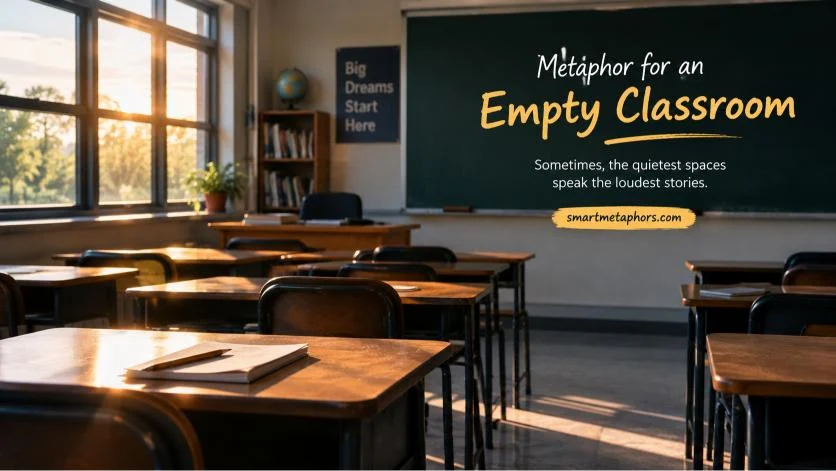
A metaphor for an empty classroom can turn an ordinary vacant room into a powerful image of silence, loneliness, memory, or change. Instead of simply saying that nobody is in the classroom, a writer can describe it as a sleeping theater, a forgotten book, or a stage after the final performance.
An empty classroom can carry many meanings. It might feel peaceful after a busy school day, lonely after students leave, or nostalgic when it reminds someone of the past.
This makes the classroom a rich setting for creative writing, poetry, essays, stories, and descriptive passages.
Key Takeaways
- Empty classrooms can symbolize silence, absence, loneliness, or memory.
- Metaphors make an ordinary classroom feel more vivid.
- Different comparisons create different emotional effects.
- The best metaphor depends on the mood of the scene.
- Small classroom details can inspire powerful imagery.
- Silence can be described as something physical, emotional, or symbolic.
What Is a Metaphor?
Simple Definition
A metaphor directly compares one thing to another without using “like” or “as.”
For example:
“The classroom was a sleeping theater.”
The classroom is not literally a theater. The metaphor suggests that it once contained activity and voices but is now silent.
Why Metaphors Work
Metaphors help readers imagine an environment rather than simply receive information about it.
Compare:
“The classroom was empty.”
with:
“The classroom was a stage after the final curtain.”
The second sentence creates a sense of absence, silence, and finality.
How Metaphors Express an Empty Classroom
An empty classroom can represent different emotions depending on the context.
Silence
A vacant classroom may feel completely still.
“The classroom was a sleeping bell.”
Loneliness
The room can feel abandoned without the students who normally fill it.
“The classroom was an island without its inhabitants.”
Memory
Desks, books, and boards can preserve traces of earlier activity.
“The classroom was a museum of yesterday.”
Peace
An empty room can also create a calm atmosphere.
“The classroom was a quiet harbor.”
Change
A classroom after students leave can symbolize the passing of time.
“The classroom was a page after the story ended.”
Metaphors for an Empty Classroom
Poetic Metaphors for an Empty Classroom
A stage after the final curtain
Meaning: The classroom feels abandoned after all activity has ended.
Best Use: Poetry and emotional storytelling.
Tone: Melancholic
A sleeping theater
Meaning: The room is quiet after once being full of voices and movement.
Best Use: Creative descriptions.
Tone: Poetic
A museum of yesterday
Meaning: The classroom preserves memories of what happened there before.
Best Use: Nostalgic writing.
Tone: Reflective
A book with its final page turned
Meaning: Something meaningful has ended.
Best Use: Endings and farewell scenes.
Tone: Emotional
A song after its final note
Meaning: The classroom has fallen completely silent.
Best Use: Poetry.
Tone: Melancholic
A frozen moment in time
Meaning: Everything feels still and suspended.
Best Use: Atmospheric writing.
Tone: Dreamlike
A forgotten chapter
Meaning: The classroom feels connected to something from the past.
Best Use: Nostalgic stories.
Tone: Thoughtful
A silent canvas
Meaning: The empty room is waiting for something to happen.
Best Use: Creative writing.
Tone: Artistic
A clock without hands
Meaning: Time seems to have stopped inside the room.
Best Use: Mysterious scenes.
Tone: Haunting
A whisper trapped in walls
Meaning: Memories of old voices seem to remain.
Best Use: Emotional or nostalgic writing.
Tone: Haunting
Emotional Metaphors for an Empty Classroom
A heart without its heartbeat
Meaning: The classroom feels lifeless without its students.
Best Use: Emotional storytelling.
Tone: Sad
A home without its family
Meaning: The room feels incomplete without the people who belong there.
Best Use: Nostalgic writing.
Tone: Emotional
A nest after the birds have flown
Meaning: The students have left, leaving the room behind.
Best Use: School memories.
Tone: Bittersweet
A smile without a face
Meaning: Something remains, but its life and energy are gone.
Best Use: Poetic writing.
Tone: Melancholic
A shadow of yesterday
Meaning: The classroom reminds the observer of its former life.
Best Use: Reflective essays.
Tone: Nostalgic
A photograph with everyone missing
Meaning: The room contains the setting but not the people who gave it meaning.
Best Use: Emotional fiction.
Tone: Sad
An echo without a voice
Meaning: The classroom feels connected to sounds that are no longer there.
Best Use: Poetry.
Tone: Haunting
A garden after the flowers have fallen
Meaning: The classroom has lost the energy it once had.
Best Use: Literary descriptions.
Tone: Melancholic
Nature-Inspired Metaphors for an Empty Classroom
A forest without birds
Meaning: The environment is present, but its usual life is missing.
Best Use: Descriptive writing.
Tone: Quiet
A lake without ripples
Meaning: Complete stillness.
Best Use: Peaceful scenes.
Tone: Calm
A field after the harvest
Meaning: Something productive has finished.
Best Use: End-of-school-day scenes.
Tone: Reflective
A winter garden
Meaning: The classroom feels quiet and lifeless.
Best Use: Somber writing.
Tone: Melancholic
A cloudless sky at midnight
Meaning: Vast, quiet, and empty.
Best Use: Poetic descriptions.
Tone: Mysterious
A river without a current
Meaning: The usual movement has disappeared.
Best Use: Symbolic writing.
Tone: Still
A deserted nest
Meaning: The people who once occupied the room have gone.
Best Use: Nostalgic scenes.
Tone: Bittersweet
A field waiting for rain
Meaning: The classroom feels empty but ready for new activity.
Best Use: Hopeful writing.
Tone: Optimistic
Funny and Lighthearted Metaphors
A library after everyone lost their books
Meaning: An unusually quiet classroom.
Best Use: Humorous writing.
Tone: Funny
A theater with no actors
Meaning: The room is ready for activity, but nobody is there.
Best Use: Casual descriptions.
Tone: Playful
A school bus without passengers
Meaning: Everything is ready, but everyone has gone.
Best Use: Lighthearted writing.
Tone: Casual
A lunchbox without lunch
Meaning: Something important seems to be missing.
Best Use: Children’s writing.
Tone: Playful
A classroom on airplane mode
Meaning: Completely disconnected from its usual activity.
Best Use: Social media and modern writing.
Tone: Humorous
Mysterious Metaphors for an Empty Classroom
A locked secret
Meaning: The classroom seems to be hiding something.
Best Use: Mystery stories.
Tone: Suspenseful
A sleeping giant
Meaning: The room appears inactive but feels as if something could happen.
Best Use: Fiction.
Tone: Mysterious
A forgotten kingdom
Meaning: The classroom feels abandoned and strangely isolated.
Best Use: Fantasy writing.
Tone: Dramatic
A door into yesterday
Meaning: Entering the classroom brings memories of the past.
Best Use: Nostalgic fiction.
Tone: Mysterious
A ghost of the school day
Meaning: The room feels like a remnant of earlier activity.
Best Use: Atmospheric writing.
Tone: Haunting
Simple Metaphors for Beginners
A sleeping room
A silent stage
A forgotten book
A quiet island
A frozen moment
An empty nest
A silent song
A sleeping school
A room without a heartbeat
A page after the story
These simple metaphors work well for students because their meanings are easy to understand while still creating imagery.
How to Choose the Right Metaphor for an Empty Classroom
Think About the Mood
Ask what the classroom should make the reader feel.
For sadness, use imagery such as:
“A heart without its heartbeat.”
For nostalgia:
“A museum of yesterday.”
For peace:
“A quiet harbor.”
For mystery:
“A locked secret.”
Consider the Time of Day
An empty classroom in the afternoon may feel peaceful.
An empty classroom at midnight may feel mysterious.
An empty classroom after graduation may feel emotional.
Focus on Small Details
Look at:
- Empty desks
- Dusty chalkboards
- Abandoned notebooks
- Open windows
- Quiet clocks
- Forgotten pencils
- Faded posters
These details can inspire stronger metaphors.
Expert Writing Tips
Show the Silence
Don’t simply tell readers the classroom is quiet.
Try:
“The walls swallowed every sound.”
This makes the silence feel physical.
Use Objects as Symbols
An abandoned notebook can represent unfinished stories.
An empty chair can represent absence.
A clock can represent passing time.
A dusty board can represent forgotten lessons.
Match the Metaphor to the Story
If your story is about graduation, choose a metaphor involving endings or memories.
If it is a horror story, choose darker imagery.
If it is a peaceful scene, use gentle natural imagery.
Avoid Making Every Metaphor Sad
An empty classroom doesn’t always represent loneliness.
It can also represent:
- Peace
- Freedom
- Possibility
- Reflection
- Waiting
- New beginnings
This gives your writing more emotional range.
Common Mistakes to Avoid
Using the Same Image Repeatedly
Constantly comparing the classroom to a ghost or graveyard can make your writing predictable.
Try using different sources of imagery.
Making the Metaphor Too Complicated
A metaphor should create an image quickly.
If readers need several sentences to understand it, simplify it.
Ignoring Context
A peaceful classroom and a frightening classroom need different metaphors.
Using Forced Imagery
Don’t choose a metaphor simply because it sounds poetic.
Make sure it actually connects to the scene.
Metaphor vs Simile
Metaphor
“The classroom was a sleeping theater.”
This directly identifies the classroom with a theater.
Simile
“The classroom was like a sleeping theater.”
This makes the comparison more explicit.
Which One Should You Use?
Use a metaphor when you want a stronger, more direct image.
Use a simile when you want the comparison to feel clearer or softer.
Frequently Asked Questions
What is a metaphor for an empty classroom?
A metaphor for an empty classroom could be “a stage after the final curtain.” It suggests that the room was once full of activity but is now silent.
How do you describe an empty classroom creatively?
You can describe it as a sleeping theater, a museum of yesterday, a forgotten chapter, or a heart without its heartbeat.
What does an empty classroom symbolize?
An empty classroom can symbolize loneliness, silence, memory, change, the end of an era, peace, or a new beginning.
What is a poetic way to describe an empty classroom?
A poetic description could be:
“The classroom was a song after its final note.”
This suggests deep silence after a period of activity.
What is a metaphor for a silent classroom?
“The classroom was a sleeping theater” is a strong metaphor for a room that has lost its usual voices and movement.
How can I describe an empty classroom in creative writing?
Focus on sensory details such as empty chairs, fading sunlight, dusty boards, ticking clocks, and abandoned books. Then connect those details to an image that matches the mood.
Conclusion
The best metaphor for an empty classroom does more than describe an absence of students. It gives the silence a meaning.
An empty classroom can become a sleeping theater, a museum of yesterday, a forgotten chapter, or a heart without its heartbeat. Each comparison creates a different emotional experience.
When choosing your own metaphor, consider the mood, setting, time of day, and details surrounding the classroom. A carefully chosen comparison can turn an ordinary empty room into a powerful symbol of memory, loneliness, peace, change, or possibility.

My Name is Alex Gard. I’m passionate about language, creative writing, and figurative expressions. Through SmartMetaphors, I help readers discover meaningful metaphors, similes, and literary devices to make their writing more engaging and impactful.