
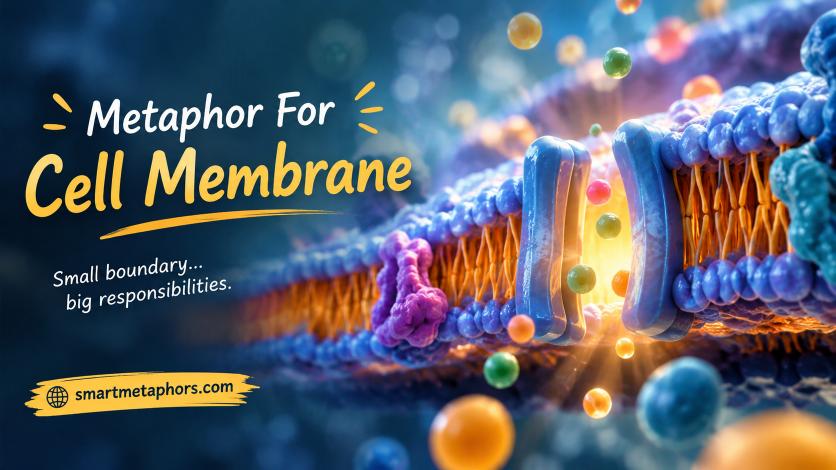
A metaphor for cell membrane can turn a complicated biology concept into something simple, visual, and easy to remember. Imagine a tiny boundary surrounding a living cell, protecting its contents while carefully deciding which substances can pass through.
The cell membrane works much like a security gate, a selective doorway, or a smart filter. These comparisons help students understand its role without getting lost in scientific terminology.
Whether you’re studying biology, preparing for an exam, teaching a classroom, or looking for a creative way to explain cell structure, these metaphors will help you understand how the cell membrane keeps a cell functioning.
Key Takeaways
- The cell membrane surrounds the cell and separates its internal environment from the outside.
- It is selectively permeable, meaning some substances can cross more easily than others.
- Metaphors make its protective and regulatory functions easier to understand.
- The cell membrane is flexible, dynamic, and involved in communication.
- A good metaphor explains a specific function without suggesting that the membrane works exactly like a human-made object.
What Is a Cell Membrane?
The cell membrane is a thin, flexible boundary surrounding a cell. It consists mainly of a phospholipid bilayer with proteins and other molecules that help the cell function.
Its main functions include:
- Protecting the cell’s internal contents.
- Regulating the movement of substances into and out of the cell.
- Helping cells communicate with their surroundings.
- Supporting the maintenance of a stable internal environment.
The membrane is selectively permeable, not completely sealed. Water, ions, nutrients, and other substances cross through different mechanisms depending on their properties and the membrane’s transport systems.
Why Use Metaphors to Explain the Cell Membrane?
Biology often describes processes that are too small to see with the naked eye. Metaphors connect these invisible processes to familiar objects and experiences.
For example, comparing a cell membrane to a security checkpoint helps explain selective permeability. Comparing it to a flexible fence helps explain how it forms a boundary without becoming a rigid wall.
The best metaphor highlights one particular function and helps the reader remember it.
Metaphors for Cell Membrane
The Cell Membrane Is a Security Gate
Meaning: The membrane controls which substances enter and leave the cell.
Best Use: Explaining selective permeability to beginners.
Tone: Simple and educational.
Example: The cell membrane is a security gate, checking what can enter the cell and what must stay outside.
The Cell Membrane Is a Border Checkpoint
Meaning: The membrane separates the cell’s interior from its surroundings while regulating movement across the boundary.
Best Use: Biology lessons about cell boundaries.
Tone: Informative.
Example: The cell membrane is a border checkpoint between the cell and the outside world.
The Cell Membrane Is a Smart Filter
Meaning: The membrane allows some substances to cross while restricting others.
Best Use: Explaining selective permeability.
Tone: Clear and scientific.
Example: The cell membrane is a smart filter that helps control the flow of materials into and out of the cell.
The Cell Membrane Is a Flexible Fence
Meaning: The membrane creates a boundary around the cell while remaining flexible.
Best Use: Describing the cell’s structure.
Tone: Visual and accessible.
Example: The cell membrane is a flexible fence that protects the cell without trapping it in a rigid shell.
The Cell Membrane Is a Guarded Doorway
Meaning: Certain substances can cross through specific channels or transport proteins.
Best Use: Explaining membrane proteins.
Tone: Educational.
Example: The cell membrane is a guarded doorway, with specialized proteins helping particular substances cross.
The Cell Membrane Is a Living Security System
Meaning: The membrane does more than block unwanted entry; it also helps recognize signals and regulate interactions.
Best Use: Explaining membrane receptors and transport.
Tone: Scientific and descriptive.
Example: The cell membrane is a living security system that protects the cell and responds to signals from its environment.
The Cell Membrane Is a Selective Bridge
Meaning: The membrane provides controlled routes between the cell’s interior and exterior.
Best Use: Explaining the movement of nutrients and ions.
Tone: Creative and informative.
Example: The cell membrane is a selective bridge connecting the cell to the resources it needs.
The Cell Membrane Is a Bouncer at a Club
Meaning: The membrane restricts entry according to the properties of substances and the transport mechanisms available.
Best Use: Informal classroom explanations.
Tone: Funny and memorable.
Example: The cell membrane is a bouncer at a club, allowing certain guests through while turning others away.
The Cell Membrane Is a Protective Raincoat
Meaning: The membrane forms a boundary that helps keep the cell’s contents separate from the outside environment.
Best Use: Introducing the protective role of membranes.
Tone: Simple.
Example: The cell membrane is a protective raincoat around the cell, helping it maintain its own internal environment.
Scientific note: Unlike a raincoat, the cell membrane is not waterproof to everything. It permits selective movement of substances.
The Cell Membrane Is a Communication Center
Meaning: Membrane proteins and receptors help the cell detect and respond to external signals.
Best Use: Explaining cell signaling.
Tone: Scientific.
Example: The cell membrane is a communication center that helps the cell receive messages from its surroundings.
The Cell Membrane Is a Controlled Turnstile
Meaning: Some substances pass through particular routes, while others need different transport mechanisms.
Best Use: Teaching membrane transport.
Tone: Practical.
Example: The cell membrane is a controlled turnstile, regulating the passage of materials through specific routes.
The Cell Membrane Is a Flexible Envelope
Meaning: The membrane surrounds the cell and helps separate its contents from the environment.
Best Use: Basic biology lessons.
Tone: Easy to understand.
Example: The cell membrane is a flexible envelope that holds the cell’s boundary together.
The Cell Membrane Is a Customs Office
Meaning: The membrane regulates the exchange of materials between the cell and its surroundings.
Best Use: Explaining selective transport.
Tone: Creative and educational.
Example: The cell membrane is a customs office that regulates the movement of materials across the cell’s border.
The Cell Membrane Is a Gatekeeper of Life
Meaning: The membrane helps maintain the conditions the cell needs to survive.
Best Use: Essays and biology presentations.
Tone: Powerful and descriptive.
Example: The cell membrane is a gatekeeper of life, managing exchanges that keep the cell functioning.
The Cell Membrane Is a Two-Way Passage
Meaning: Materials can move both into and out of the cell, depending on the substance and transport process.
Best Use: Explaining membrane transport.
Tone: Straightforward.
Example: The cell membrane is a two-way passage through which a cell exchanges materials with its environment.
Metaphors for Different Cell Membrane Functions
Protection
Metaphor: The cell membrane is a protective shield.
It separates the cell’s internal contents from the external environment. However, unlike a solid shield, it is flexible and allows selected substances to cross.
Selective Permeability
Metaphor: The cell membrane is a selective doorway.
Some substances can cross the lipid bilayer directly, while others require channels, carriers, or energy-dependent transport.
Communication
Metaphor: The cell membrane is an antenna.
This comparison highlights how membrane receptors detect chemical signals and help the cell respond to changes around it.
Maintaining Balance
Metaphor: The cell membrane is a careful caretaker.
It helps the cell maintain suitable internal conditions by regulating the movement of water, ions, nutrients, and waste products.
Transport
Metaphor: The cell membrane is a network of controlled roads.
Different transport proteins provide routes for particular substances to cross the membrane.
Metaphor vs. Simile
A metaphor directly describes one thing as another. A simile compares two things using words such as like or as.
Metaphor
“The cell membrane is a security gate.”
Directly identifies the membrane with a gate to explain its regulatory role.
Simile
“The cell membrane is like a security gate.”
Makes the comparison explicit using the word “like.”
Both forms help readers understand a scientific idea. Metaphors are often concise, while similes can make a comparison more explicit for beginners.
How to Choose the Right Metaphor for a Cell Membrane
Consider What You Want to Explain
Choose the metaphor according to the membrane function you’re discussing:
- Protection: A shield or protective fence.
- Selective permeability: A security gate or selective doorway.
- Cell signaling: An antenna or communication center.
- Transport: A controlled turnstile or network of roads.
- Internal balance: A careful caretaker.
Match the Audience
For younger students, a guarded doorway may be easier to understand than a customs office. For advanced biology students, a transport network can help introduce channels, carriers, and energy-dependent movement.
Keep the Science Accurate
No metaphor explains every aspect of the cell membrane. A security gate, for instance, suggests controlled access but does not explain the phospholipid bilayer or how molecules diffuse across it.
Use the comparison to introduce the concept, then explain the actual biological process.
Expert Tips for Writing About the Cell Membrane
Connect the Metaphor to a Scientific Fact
Instead of using a metaphor alone, explain the biological principle behind it.
Example: The cell membrane is a selective doorway because its phospholipid bilayer and transport proteins determine how different substances cross.
Avoid Treating the Membrane as a Solid Wall
A cell membrane is dynamic and flexible. It can change shape, interact with other membranes, and participate in processes such as endocytosis and exocytosis.
Choose One Main Image
Avoid combining a gate, a shield, a road, and an antenna in the same sentence. One clear comparison is usually more effective than several competing images.
Common Mistakes to Avoid
Saying the Membrane Blocks Everything
A cell membrane does not stop all substances. Its permeability varies according to molecular properties and available transport mechanisms.
Better description: The cell membrane selectively regulates the movement of substances.
Confusing the Cell Membrane With the Cell Wall
Some cells, including plant cells and bacteria, have a cell wall outside the cell membrane. Animal cells do not have a cell wall.
Better metaphor: The cell membrane is the controlled entrance to the cell, while a cell wall, when present, provides additional structural support.
Assuming All Transport Requires Energy
Some substances cross by passive processes, such as diffusion and facilitated diffusion. Other substances require energy, including active transport.
Better description: The cell membrane supports several forms of transport, some passive and some energy-dependent.
Frequently Asked Questions
What is a metaphor for a cell membrane?
A useful metaphor for a cell membrane is a security gate because it regulates which substances can enter and leave the cell.
What is the best metaphor for the cell membrane?
A security gate is one of the clearest metaphors because it explains selective permeability. A flexible fence is useful for explaining the membrane’s boundary and flexibility.
Why is the cell membrane compared to a gatekeeper?
The cell membrane is compared to a gatekeeper because it regulates the movement of substances between the cell’s interior and its surroundings.
Is the cell membrane like a wall?
The cell membrane forms a boundary like a wall, but it is much more flexible and selectively permeable. It allows certain substances to cross through the lipid bilayer or specialized transport proteins.
How does a metaphor help students understand the cell membrane?
A metaphor connects an unfamiliar biological structure to a familiar object. This helps students remember functions such as protection, selective permeability, transport, and communication.
What is a metaphor for selective permeability?
A selective doorway is a useful metaphor for selective permeability because it illustrates how some substances can cross the membrane more easily than others.
Conclusion
A metaphor for cell membrane makes an important biology concept easier to understand by connecting the membrane’s functions to familiar objects. A security gate explains selective permeability, a flexible fence illustrates its boundary, and an antenna captures its role in cell communication.
The most useful metaphor depends on the function you want to explain. By pairing creative comparisons with accurate scientific details, you can make cell biology easier to learn, teach, and remember.

My Name is Alex Gard. I’m passionate about language, creative writing, and figurative expressions. Through SmartMetaphors, I help readers discover meaningful metaphors, similes, and literary devices to make their writing more engaging and impactful.