
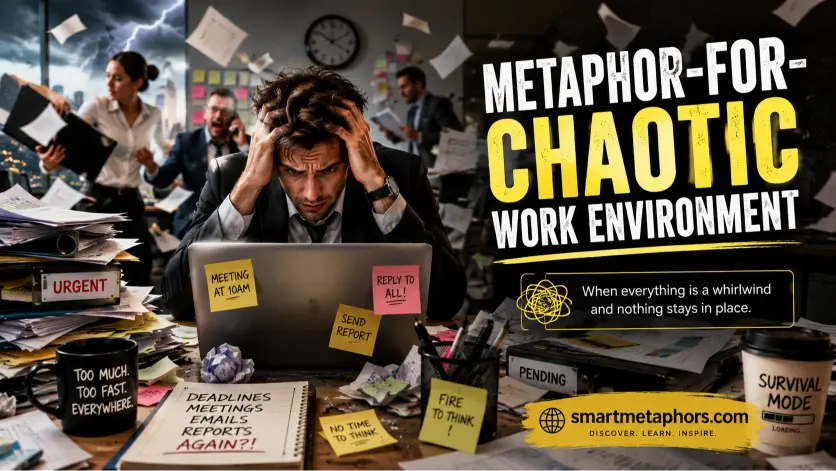
A metaphor for chaotic work environment can turn an ordinary description of workplace disorder into a vivid picture that readers immediately understand. Instead of simply saying that an office is stressful or disorganized, you can describe it as a storm, a runaway train, or a puzzle with missing pieces.
These comparisons are useful in workplace stories, essays, novels, business writing, speeches, articles, and creative descriptions.
The strongest metaphor does more than say that a workplace is chaotic. It shows what kind of chaos exists—constant interruptions, missed deadlines, confused communication, overwhelming workloads, poor leadership, or employees rushing from one crisis to another.
Key Takeaways
- Workplace chaos can be expressed through vivid metaphors.
- Different metaphors emphasize different types of disorder.
- Storm, traffic, battlefield, circus, and machinery imagery work especially well.
- Professional writing benefits from controlled and thoughtful comparisons.
- Creative writing allows more dramatic and unusual imagery.
- The best metaphor matches the exact type of workplace chaos.
What Is a Metaphor?
Definition of a Metaphor
A metaphor directly compares one thing with another without using “like” or “as.”
For example:
“The office was a storm.”
The office is not literally a storm. The metaphor suggests noise, movement, pressure, and unpredictability.
Why Metaphors Work for Workplace Chaos
“Chaotic workplace” tells the reader what exists.
“The office was a train with no brakes” shows the reader how that chaos feels.
That difference makes metaphor especially useful for creative and descriptive writing.
What Makes a Work Environment Chaotic?
Workplace chaos can come from many sources:
- Constant interruptions
- Unclear responsibilities
- Unrealistic deadlines
- Poor communication
- Last-minute changes
- Too many meetings
- Conflicting instructions
- Heavy workloads
- Weak organization
- Frequent emergencies
Because chaos has different forms, your metaphor should capture the specific problem rather than simply describe everything as “a mess.”
Metaphor for Chaotic Work Environment
Storm and Weather Metaphors
The office was a storm trapped indoors.
Meaning: The workplace is filled with pressure, movement, noise, and unpredictable problems.
Best Use: General workplace chaos.
Tone: Dramatic
The workplace was a hurricane of deadlines.
Meaning: Deadlines were arriving from every direction.
Best Use: Overwhelming workloads.
Tone: Intense
The office was thunder without silence.
Meaning: Constant noise and tension never seemed to stop.
Best Use: Extremely busy workplaces.
Tone: Dramatic
The team was caught in a whirlwind of tasks.
Meaning: Employees were constantly moving between competing responsibilities.
Best Use: Busy professional environments.
Tone: Energetic
The company was sailing through a permanent storm.
Meaning: Problems were continuous rather than temporary.
Best Use: Long-term organizational disorder.
Tone: Serious
Traffic and Transportation Metaphors
The office was a traffic jam with no traffic lights.
Meaning: Everyone was moving without coordination.
Best Use: Poorly organized teams.
Tone: Relatable
The workplace was a runaway train.
Meaning: Events were moving too quickly for anyone to control them.
Best Use: Fast-growing or poorly managed environments.
Tone: Powerful
The team was a fleet heading in different directions.
Meaning: Employees lacked a shared goal.
Best Use: Leadership and communication problems.
Tone: Professional
The office was an airport during a storm.
Meaning: Constant delays, confusion, changes, and frustrated people.
Best Use: Customer service or operations environments.
Tone: Descriptive
The company was a car with every driver fighting for the wheel.
Meaning: Too many people were trying to control decisions.
Best Use: Leadership conflicts.
Tone: Critical
Machinery Metaphors
The office was a machine full of loose gears.
Meaning: The organization was operating, but important parts were not working together.
Best Use: Organizational problems.
Tone: Professional
The team was an engine running without oil.
Meaning: Employees were functioning under damaging pressure.
Best Use: Burnout and overwork.
Tone: Serious
The company was a clock with broken hands.
Meaning: The workplace had lost its sense of direction and timing.
Best Use: Poor planning.
Tone: Reflective
The office was a computer with too many programs running.
Meaning: Too many tasks and demands were happening simultaneously.
Best Use: Modern office environments.
Tone: Casual
The workflow was a tangled bundle of wires.
Meaning: Processes had become complicated and difficult to manage.
Best Use: Operational problems.
Tone: Professional
Battle and Conflict Metaphors
The office was a battlefield of competing priorities.
Meaning: Different goals were constantly clashing.
Best Use: High-conflict workplaces.
Tone: Dramatic
Every deadline was another enemy at the gate.
Meaning: Employees felt constantly threatened by approaching deadlines.
Best Use: Stressful projects.
Tone: Dramatic
The meeting room was a war room without a strategy.
Meaning: People were dealing with serious problems without a clear plan.
Best Use: Poorly managed projects.
Tone: Critical
The team was fighting fires with empty buckets.
Meaning: Employees were expected to solve problems without enough resources.
Best Use: Understaffed organizations.
Tone: Powerful
The workplace was a siege of endless emergencies.
Meaning: Workers felt surrounded by continuous crises.
Best Use: Extremely stressful environments.
Tone: Intense
Funny Metaphors for a Chaotic Office
The office was a circus with spreadsheets.
Meaning: The workplace was absurdly busy but still trying to appear professional.
Best Use: Humor and social media.
Tone: Funny
The break room was the calmest battlefield.
Meaning: Even ordinary spaces felt connected to workplace chaos.
Best Use: Lighthearted workplace writing.
Tone: Humorous
The office was a group chat that escaped into real life.
Meaning: Everyone was talking, reacting, and creating confusion at once.
Best Use: Modern workplace humor.
Tone: Playful
The team was a marching band without a conductor.
Meaning: Everyone was making noise without coordination.
Best Use: Teamwork problems.
Tone: Funny
The workplace was a kitchen during dinner rush.
Meaning: Everyone was rushing to complete tasks simultaneously.
Best Use: Busy workplaces.
Tone: Relatable
Professional Metaphors for Workplace Chaos
The organization was a ship without a captain.
Meaning: The workplace lacked clear leadership.
Best Use: Business writing.
Tone: Professional
The company was a puzzle missing half its pieces.
Meaning: Important information, resources, or people were missing.
Best Use: Organizational analysis.
Tone: Neutral
The workflow was a maze without signs.
Meaning: Employees could not easily determine what to do next.
Best Use: Process problems.
Tone: Professional
The workplace was a foundation built on shifting sand.
Meaning: The organization lacked stable systems.
Best Use: Business reports and essays.
Tone: Serious
The company was a compass spinning without north.
Meaning: The organization lacked clear direction.
Best Use: Leadership discussions.
Tone: Thoughtful
Powerful Metaphors for Workplace Stress
The office was a pressure cooker.
Meaning: Stress was building toward a breaking point.
Best Use: High-pressure environments.
Tone: Powerful
The workload was an avalanche.
Meaning: Tasks kept accumulating faster than employees could handle them.
Best Use: Overwhelming workloads.
Tone: Dramatic
Stress was a shadow hanging over the team.
Meaning: Anxiety affected employees even when no immediate crisis existed.
Best Use: Emotional workplace descriptions.
Tone: Serious
Every email was another stone in the backpack.
Meaning: Small demands accumulated into a heavy burden.
Best Use: Describing mental workload.
Tone: Emotional
The deadline was a ticking clock in everyone’s head.
Meaning: Employees constantly felt pressure from limited time.
Best Use: Project-based writing.
Tone: Intense
Literary and Poetic Metaphors
The office was a river overflowing its banks.
Meaning: Activity and problems had exceeded the organization’s ability to contain them.
Best Use: Literary descriptions.
Tone: Poetic
The workplace was a sky crowded with falling stars.
Meaning: Too many events were happening at once.
Best Use: Creative writing.
Tone: Poetic
The team was a symphony played without a conductor.
Meaning: Everyone was working, but coordination was missing.
Best Use: Literary or reflective writing.
Tone: Elegant
The office was a forest of tangled branches.
Meaning: Communication and responsibilities had become intertwined.
Best Use: Essays and descriptive writing.
Tone: Poetic
The workplace was a river carrying everyone downstream.
Meaning: Employees felt unable to stop or control the pace of events.
Best Use: Emotional storytelling.
Tone: Reflective
Short and Simple Metaphors
A runaway train
Meaning: Events are moving too quickly.
A pressure cooker
Meaning: Stress is building.
A tangled web
Meaning: Problems are interconnected.
A broken compass
Meaning: The team lacks direction.
A spinning wheel
Meaning: Everyone is busy but progress is limited.
A storm cloud
Meaning: Tension hangs over the workplace.
A maze
Meaning: Employees are confused about what to do.
A sinking ship
Meaning: The organization appears to be struggling badly.
A ticking bomb
Meaning: Tension could soon turn into a serious problem.
A crowded crossroads
Meaning: Too many decisions and directions compete at once.
Metaphor vs Simile
Metaphor
A metaphor makes a direct comparison.
“The office was a pressure cooker.”
Simile
A simile uses “like” or “as.”
“The office was like a pressure cooker.”
Which One Is Stronger?
Neither is automatically better.
A metaphor usually sounds more direct and powerful, while a simile makes the comparison clearer.
For a business report, a simile may feel more cautious.
For creative writing, a metaphor can create stronger imagery.
How to Choose the Right Metaphor for a Chaotic Work Environment
Identify the Type of Chaos
First ask what makes the workplace chaotic.
If deadlines are the problem, use storm or avalanche imagery.
If leadership is the problem, use ship or compass imagery.
If communication is the problem, use tangled wires or webs.
If stress is the problem, use pressure cooker imagery.
Match the Tone
A humorous article can use:
“The office was a circus with spreadsheets.”
A serious report could use:
“The organization was a ship without a captain.”
Think About Your Audience
Professional readers usually respond better to controlled metaphors.
Creative audiences may appreciate unusual and imaginative comparisons.
Expert Writing Tips
Show the Source of the Chaos
Don’t simply write:
“The workplace was a storm.”
Make the metaphor more specific:
“The workplace was a storm of missed deadlines, urgent emails, and changing instructions.”
The added details make the image easier to understand.
Use One Strong Metaphor
You rarely need several metaphors in one sentence.
A single strong comparison can be more memorable than a collection of unrelated images.
Create Fresh Comparisons
Instead of relying on familiar phrases, combine workplace ideas with unexpected imagery.
For example:
“The office was a browser with every tab demanding attention.”
This feels modern and immediately relatable.
Let the Metaphor Support the Message
A metaphor should clarify your idea rather than distract from it.
If you’re discussing poor leadership, a ship without a captain communicates the problem more clearly than an unrelated image.
Common Mistakes to Avoid
Using Too Many Metaphors
Packing several comparisons into one sentence can make your writing confusing.
Choosing a Metaphor That Is Too Dramatic
Calling a mildly busy office “a battlefield” may exaggerate the situation.
Choose imagery that matches the actual intensity.
Using Workplace Clichés
Expressions such as “putting out fires” are common and may feel predictable.
Try giving familiar ideas a fresh image instead.
Forgetting the Main Point
The metaphor should help readers understand the workplace problem.
Don’t let creativity become more important than clarity.
Frequently Asked Questions
What is a metaphor for a chaotic work environment?
A metaphor for a chaotic work environment describes workplace disorder through an imaginative comparison. “The office was a storm trapped indoors” is one example.
What is a good metaphor for a stressful workplace?
“The office was a pressure cooker” is a strong metaphor because it suggests increasing stress and the possibility of reaching a breaking point.
What metaphor describes a disorganized workplace?
“The workflow was a maze without signs” effectively describes confusion, unclear processes, and difficulty finding direction.
What is a metaphor for a busy office?
“The office was a kitchen during dinner rush” suggests constant activity, urgency, movement, and competing tasks.
How do you describe workplace chaos creatively?
Compare the workplace to something naturally associated with disorder, pressure, confusion, or uncontrolled movement, such as a storm, maze, runaway train, tangled web, or overflowing river.
What is a metaphor for poor workplace management?
“The organization was a ship without a captain” is a clear metaphor for poor leadership and lack of direction.
Can metaphors be used in professional writing?
Yes. Professional metaphors can make complex organizational problems easier to understand, provided they remain clear, relevant, and appropriately restrained.
Conclusion
The right metaphor for chaotic work environment can turn workplace disorder into an image that readers immediately understand. A storm can represent unpredictable pressure, a runaway train can represent uncontrolled momentum, and a maze can represent confusion.
For the strongest writing, identify the exact source of the chaos before choosing your metaphor. When the comparison matches the situation, audience, and tone, even a difficult workplace problem can become clear, memorable, and engaging.

My Name is Alex Gard. I’m passionate about language, creative writing, and figurative expressions. Through SmartMetaphors, I help readers discover meaningful metaphors, similes, and literary devices to make their writing more engaging and impactful.
4 thoughts on “77+ Hectic Metaphor for Chaotic Work Environment for Writers”