
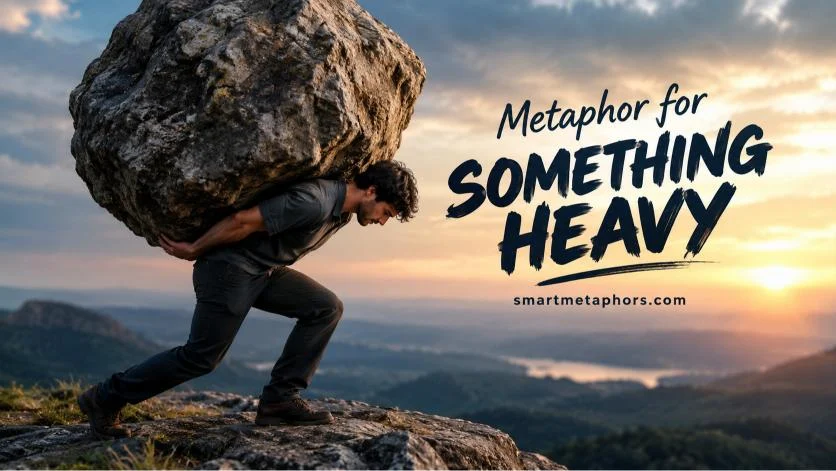
A metaphor for something heavy can describe much more than physical weight. A heavy object may become a mountain, an anchor, a burden, or an iron chain when a writer wants to make its weight easier to imagine.
The idea of heaviness also works beautifully for emotions. Grief, responsibility, stress, guilt, and sadness can all feel heavy, even though they have no physical weight.
In creative writing, the right metaphor turns an ordinary statement into an image that readers can feel.
Key Takeaways
- Metaphors can describe both physical and emotional heaviness.
- Different images communicate different kinds of weight.
- Mountains suggest enormous weight or pressure.
- Anchors suggest something that prevents movement.
- Stones can represent sadness, grief, or emotional pressure.
- Chains often suggest responsibility, guilt, or restriction.
- The strongest metaphor matches the exact type of heaviness you want to express.
What Is a Metaphor?
Definition of a Metaphor
A metaphor directly compares one thing to another without using “like” or “as.”
For example:
“The responsibility was a mountain on his shoulders.”
The responsibility is not literally a mountain. The metaphor communicates that it feels extremely difficult to carry.
Why Metaphors Make Weight More Powerful
Simply saying something is heavy gives the reader basic information.
Compare:
“The box was heavy.”
with:
“The box was an iron fortress in his arms.”
The second sentence creates a stronger physical image and gives the reader a sense of struggle.
How Metaphors Express Heaviness
Heaviness can have several meanings.
Physical Weight
A heavy object can be compared to:
- A mountain
- An anchor
- A boulder
- Iron
- A giant stone
- A loaded ship
Emotional Weight
Emotional heaviness can become:
- A storm cloud
- A stone in the chest
- A chain
- A dark cloak
- A mountain on the heart
Mental Pressure
Mental exhaustion can be represented by:
- A crowded room
- A loaded machine
- A weight pressing on the mind
- A ceiling slowly lowering
Understanding the type of heaviness helps you choose a much stronger metaphor.
Creative Metaphors for Something Heavy
Physical Weight Metaphors
A mountain in my arms
Meaning: Something feels extremely difficult to lift or carry.
Best Use: Describing an unusually heavy object.
Tone: Powerful
An anchor in my hands
Meaning: The object is difficult to move.
Best Use: Physical descriptions and storytelling.
Tone: Strong
A boulder refusing to move
Meaning: Something feels extremely heavy and immovable.
Best Use: Objects or difficult physical tasks.
Tone: Dramatic
A block of iron
Meaning: Something feels dense and extremely heavy.
Best Use: Straightforward descriptions.
Tone: Direct
A mountain of stone
Meaning: An enormous amount of weight.
Best Use: Dramatic writing.
Tone: Intense
A fallen giant
Meaning: Something large and difficult to move.
Best Use: Fiction and descriptive scenes.
Tone: Dramatic
A ship filled with stone
Meaning: An overwhelming physical load.
Best Use: Storytelling and poetry.
Tone: Vivid
An iron giant
Meaning: Something massive and difficult to handle.
Best Use: Creative descriptions of machinery or objects.
Tone: Powerful
Metaphors for Emotional Heaviness
A mountain on my heart
Meaning: A powerful emotional burden.
Best Use: Grief, sadness, or heartbreak.
Tone: Emotional
A stone in my chest
Meaning: A persistent feeling of emotional heaviness.
Best Use: Sadness, anxiety, or grief.
Tone: Intimate
An anchor around my soul
Meaning: Something emotionally prevents you from moving forward.
Best Use: Personal or reflective writing.
Tone: Poetic
A dark cloak over my spirit
Meaning: Sadness or emotional darkness covering everything.
Best Use: Poetry and literary writing.
Tone: Melancholic
A chain around my heart
Meaning: Emotional pain that feels difficult to escape.
Best Use: Heartbreak and emotional fiction.
Tone: Dramatic
A storm cloud in my mind
Meaning: Persistent emotional or mental heaviness.
Best Use: Stress, sadness, and difficult thoughts.
Tone: Reflective
A weight beneath my ribs
Meaning: An internal emotional pressure that is difficult to explain.
Best Use: Personal essays and literary writing.
Tone: Intimate
A winter inside my chest
Meaning: Deep emotional coldness or sadness.
Best Use: Poetry.
Tone: Poetic
Metaphors for Responsibility and Pressure
A mountain on my shoulders
Meaning: A huge responsibility that feels difficult to carry.
Best Use: Work, family responsibilities, or difficult obligations.
Tone: Powerful
A backpack full of stones
Meaning: Many responsibilities accumulating over time.
Best Use: Everyday writing.
Tone: Relatable
An iron crown
Meaning: A position of power that also carries a heavy burden.
Best Use: Leadership and storytelling.
Tone: Literary
A suitcase packed with bricks
Meaning: Too many responsibilities or problems carried at once.
Best Use: Casual and creative writing.
Tone: Vivid
A chain of obligations
Meaning: Responsibilities that restrict freedom.
Best Use: Professional or personal writing.
Tone: Serious
A ceiling pressing downward
Meaning: Increasing pressure with little room to escape.
Best Use: Stressful situations.
Tone: Dramatic
A burden carved from stone
Meaning: A responsibility that feels permanent and difficult.
Best Use: Literary writing.
Tone: Serious
An ocean carried in one bucket
Meaning: An impossible amount of responsibility placed on one person.
Best Use: Dramatic storytelling.
Tone: Powerful
Poetic Metaphors for Something Heavy
A sleeping giant
Meaning: Something enormous whose weight or power is quietly present.
Best Use: Poetry and fiction.
Tone: Mysterious
A planet hanging from my hands
Meaning: An almost unimaginable burden.
Best Use: Fantasy and poetic writing.
Tone: Epic
The earth resting on my shoulders
Meaning: Feeling responsible for everything around you.
Best Use: Emotional writing.
Tone: Grand
A black moon inside my heart
Meaning: A deep and persistent emotional burden.
Best Use: Poetry.
Tone: Dark and poetic
A cathedral of sorrow
Meaning: A vast and overwhelming emotional burden.
Best Use: Literary writing.
Tone: Profound
A river of stones
Meaning: Problems continuously accumulating.
Best Use: Poetry and reflective writing.
Tone: Symbolic
A sky made of iron
Meaning: A world that feels oppressive and impossible to escape.
Best Use: Fiction and poetry.
Tone: Dark
A gravity well of sorrow
Meaning: Sadness that continually pulls someone downward.
Best Use: Advanced creative writing.
Tone: Sophisticated
Simple Metaphors for Something Heavy
A giant stone
An iron block
A mountain
An anchor
A boulder
A heavy chain
A sack of rocks
A stone wall
A loaded ship
An iron door
These simple metaphors are useful for students, beginners, and everyday descriptions because their meaning is immediately clear.
Funny Metaphors for Something Heavy
A suitcase packed by a dinosaur
Meaning: Something absurdly heavy.
Best Use: Humor and casual writing.
Tone: Funny
A backpack full of planets
Meaning: An exaggerated amount of weight.
Best Use: Jokes and social media writing.
Tone: Playful
A brick wearing another brick
Meaning: Something unnecessarily heavy.
Best Use: Humorous descriptions.
Tone: Comedic
A bowling ball with ambitions
Meaning: Something heavy that seems determined to stay put.
Best Use: Casual humor.
Tone: Funny
A sleeping elephant
Meaning: Something extremely difficult to move.
Best Use: Humorous storytelling.
Tone: Playful
Metaphors for Heavy Emotions
Grief is an anchor
This suggests grief keeps someone emotionally stuck.
Guilt is a sack of stones
This suggests guilt becomes heavier as it is carried.
Stress is an iron blanket
This suggests pressure surrounds and weighs someone down.
Sadness is a sinking ship
This suggests emotional pain gradually pulls someone downward.
Fear is a locked weight
This suggests fear prevents movement or action.
Responsibility is a mountain
This suggests an enormous task that must be carried or overcome.
Metaphor vs Simile
Metaphor
A metaphor makes a direct comparison.
“The responsibility was a mountain.”
Simile
A simile uses “like” or “as.”
“The responsibility was like a mountain.”
Which One Is More Powerful?
Neither is always better. The choice depends on your writing.
A metaphor sounds more direct and confident.
A simile creates more distance between the two ideas and can make the comparison easier to understand.
How to Choose the Right Metaphor for Something Heavy
Identify What Kind of Heavy You Mean
Ask yourself whether you’re describing:
- Physical weight
- Emotional pain
- Mental pressure
- Responsibility
- Sadness
- Exhaustion
- Restriction
The answer will guide your imagery.
Match the Emotional Intensity
For mild heaviness, use something simple:
“A stone in my pocket.”
For extreme emotional weight, use something larger:
“The earth rested on my shoulders.”
Think About Movement
If the heaviness prevents someone from moving, an anchor or chain works well.
If it creates pressure, a mountain works better.
If it creates sadness, a stone in the chest may feel more personal.
Expert Writing Tips
Make the Metaphor Specific
Instead of simply writing:
“It was heavy.”
Ask what kind of heaviness the reader should feel.
For example:
“The decision was an iron door between him and tomorrow.”
Now the weight also communicates emotional restriction.
Use Unexpected Comparisons
Fresh imagery can make a familiar idea feel new.
Instead of:
“A mountain of problems.”
Try:
“A warehouse of unfinished storms.”
Use Sensory Language
Strong metaphors often activate the senses.
Words such as cold, crushing, dragging, sinking, pressing, trembling, and immovable can strengthen the image.
Don’t Make Every Metaphor Huge
Not every heavy thing needs to become a mountain or planet.
Sometimes a small metaphor creates greater emotional realism:
“The news was a stone in her pocket.”
Common Mistakes to Avoid
Using the Same Metaphor Repeatedly
Mountains, anchors, and weights are effective, but using them too often can make your writing predictable.
Making the Comparison Too Complicated
A metaphor should create an image, not require a paragraph of explanation.
Confusing Physical and Emotional Weight
Make sure the surrounding context tells the reader whether the heaviness is literal or symbolic.
Overusing Exaggeration
Saying every problem is “the weight of the universe” can weaken the emotional effect.
Save extreme imagery for moments that truly deserve it.
Frequently Asked Questions
What is a metaphor for something heavy?
A metaphor for something heavy compares weight to another powerful image, such as a mountain, anchor, boulder, chain, or iron block.
What is a metaphor for emotional heaviness?
Examples include “a mountain on my heart,” “a stone in my chest,” and “an anchor around my soul.” These describe emotional burdens without referring to literal weight.
What is a metaphor for carrying a heavy burden?
“A mountain on my shoulders” is a strong metaphor for carrying a difficult responsibility or emotional burden.
What is a metaphor for something that weighs you down?
“An anchor around my soul” suggests that something is preventing you from moving forward emotionally or mentally.
How do you describe something heavy creatively?
Compare it to something large, dense, difficult to move, or emotionally powerful. Mountains, anchors, iron, boulders, chains, and planets can all create strong images.
Can heavy metaphors describe emotions?
Yes. Metaphors are especially useful for emotions because feelings such as grief, guilt, stress, and sadness can be described as weights even though they have no physical mass.
Conclusion
The best metaphor for something heavy depends on what kind of heaviness you want your reader to experience. A mountain can represent overwhelming pressure, an anchor can suggest being held back, while a stone in the chest can communicate quiet emotional pain.
When you choose an image that matches the exact feeling, your writing becomes clearer, more vivid, and more memorable. Instead of simply telling readers that something is heavy, you give them an image they can see, feel, and understand.

My Name is Alex Gard. I’m passionate about language, creative writing, and figurative expressions. Through SmartMetaphors, I help readers discover meaningful metaphors, similes, and literary devices to make their writing more engaging and impactful.